
Sheet vs Powdered Gelatin: Bloom, Weight and Soaking
Compare leaf and powdered gelatin by dry weight and Bloom strength, account for soaking water and use a small side-by-side test to judge the set.

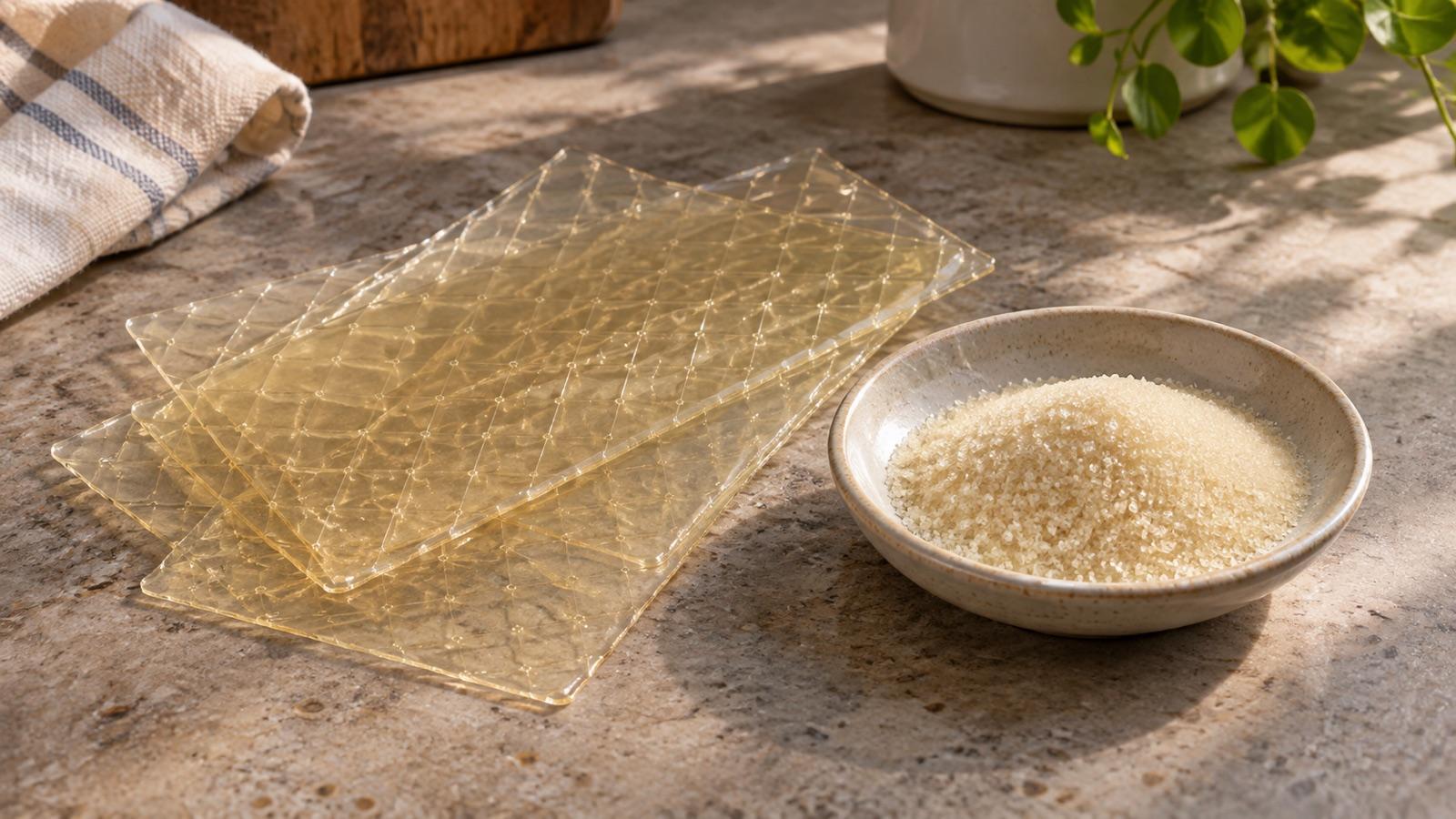
Compare sheet and powdered gelatin by dry weight and Bloom strength. Equal dry weights are a starting point when the two products have the same Bloom rating. Count the soaking water if it goes into the recipe. If you cannot establish the strength of a product, test it in a small portion of the liquid you plan to use.
Read Bloom and dry weight together
Bloom measures the firmness of a gelatin gel prepared under standard conditions. A higher-Bloom product usually produces a firmer gel at the same weight under the same conditions. The laboratory conditions are fixed. In the kitchen, the composition of the liquid, the gelatin concentration and the chilling time can all change. The manufacturer’s page on GELITA’s Bloom measurement guide explains how the measurement is defined.
If a recipe calls for 4 sheets, find the dry weight of the sheets it specifies. At 2 g per sheet, 4 sheets weigh 8 g. Sheets weighing 2.5 g each would give you 10 g for the same count. If the packet lists only net weight and sheet count, divide one by the other. If you have an open packet, weigh several dry sheets and take the average. See how to tare a kitchen scale for weighing them. Treat colour names as product labels and look for the technical specification or recommended dose if Bloom is missing from the pack.
Hydrate each form separately
Submerge the sheets in a wide bowl of cold water with space between them. Follow the pack’s timing and check that the corners have softened. Lift the sheets out, gently squeeze off excess water and dissolve them in a warm or hot portion of the recipe liquid. Check for any translucent strips left at the folds. The GELITA guide to sheet gelatin shows the process.
Scatter the powder in a thin layer over measured cold water. Use a bowl wide enough for the water to reach all the granules. In the Debic preparation example, 5 g powdered gelatin and 25 g cold water make 30 g hydrated mixture. Follow your pack if it specifies another ratio or waiting time. Add all of the swollen mixture to the warm or hot base and stir until dissolved.
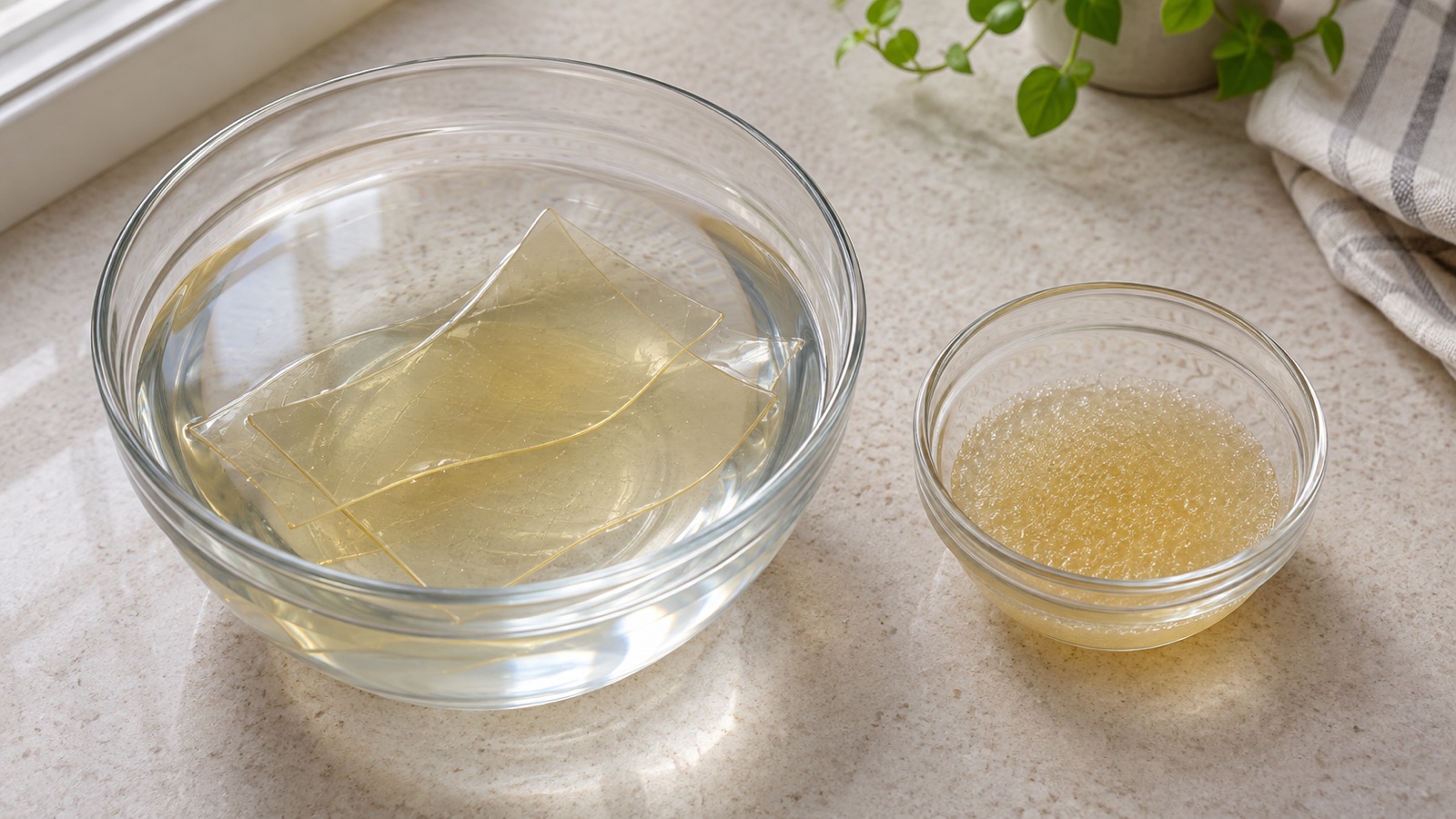
Illustration of the two soaking methods.
Keep track of the liquid when swapping
If the recipe uses 8 g dry sheets at the same Bloom, you can trial 8 g dry powder. If the recipe includes water, take the soaking water from that amount. For a recipe using 400 g water and a packet directing you to use five times the weight of the powder, set aside 40 g cold water for soaking and keep 360 g for the rest. Squeezed sheets still carry some water, so check the finished texture, particularly in small or delicate layers.
When a recipe lists only “gelatin mass”, find the formula for that mass first. In a mixture of one part powder to five parts water, 5 g of a 30 g gelatin mass is dry gelatin. A different hydration ratio changes the calculation. In a cream-based dessert, reducing cream to compensate for added water also changes the fat content. Start with the manufacturer’s dose in a small sample and return to the original formula if needed.
Compare the set in two small bowls For example, a recipe using 6 g dry gelatin per 500 g liquid scales to 1.2 g for a 100 g sample. That calculation preserves the original recipe’s ratio. Stir both samples the same way so that differences in aeration do not skew the spoon test.
Make equal samples of the milk, cream or strained fruit mixture you intend to use. For example, scale the recipe’s dose per gram down to two 100 g portions. Add the specified product to one and the substitute to the other. If you have only the substitute, try two doses close to its label guidance. Increase the sample size if the scale cannot resolve the difference.
Account for the soaking water and fill the bowls to equal depths at the same temperature. Chill perishable samples for the same length of time on the same shelf of a refrigerator at 4 °C or colder. See USDA refrigeration guidance for refrigeration guidance. Test both with the same spoon. For a dessert served in a glass, look for easy spooning. For a moulded dessert, check whether the edge releases cleanly. Record the product, dose, liquid and chilling time.
Fix lumps and unexpected textures
If you pile the powder in one spot, the wet outside can trap dry granules inside. Use a wider surface next time. If adding dissolved gelatin to cold fruit purée makes strands, stir a little purée into the gelatin first to narrow the temperature difference, then blend that mixture into the rest.
If the gel is too soft, check chilling time, dry weight, Bloom and added water. If it is too firm, reduce the dry dose in the next test and keep the liquid and fruit proportions fixed. You can then tell which adjustment changed the texture. Write down both the weight and product name so you can repeat the test when you change brands.
İyi Bir Yemek
Food Researcher & Writer
Reader Comments & Contributions
Be the first to share your thoughts on this post