
How to Use a Dough Scraper for Bowls and Worktops
Learn which edge of a dough scraper to use for lifting sticky dough, dividing bread rolls and cleaning the worktop. Compare metal and flexible tools.

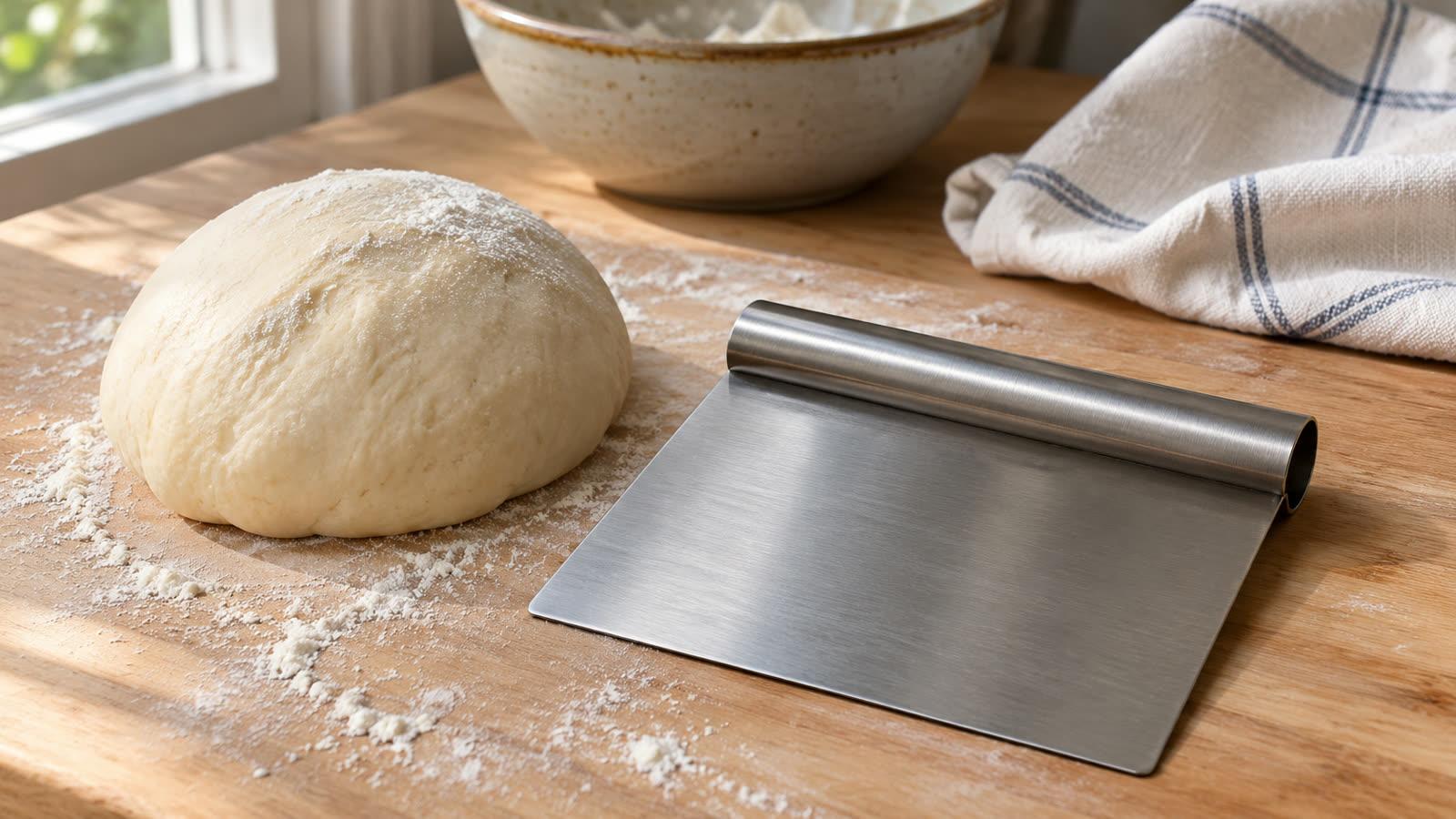
A dough scraper lets you lift, divide and move dough without having to dig your fingers into it. Use a rigid straight edge to divide dough on a worktop and a flexible curve to clear a mixing bowl. Change your angle with the job. Hold the edge upright for a cut, lower it towards the worktop to lift a piece, and fit the curve against the bowl to scrape. Each movement solves a different problem, even when you are working with the same dough.
Bench scraper or bowl scraper?
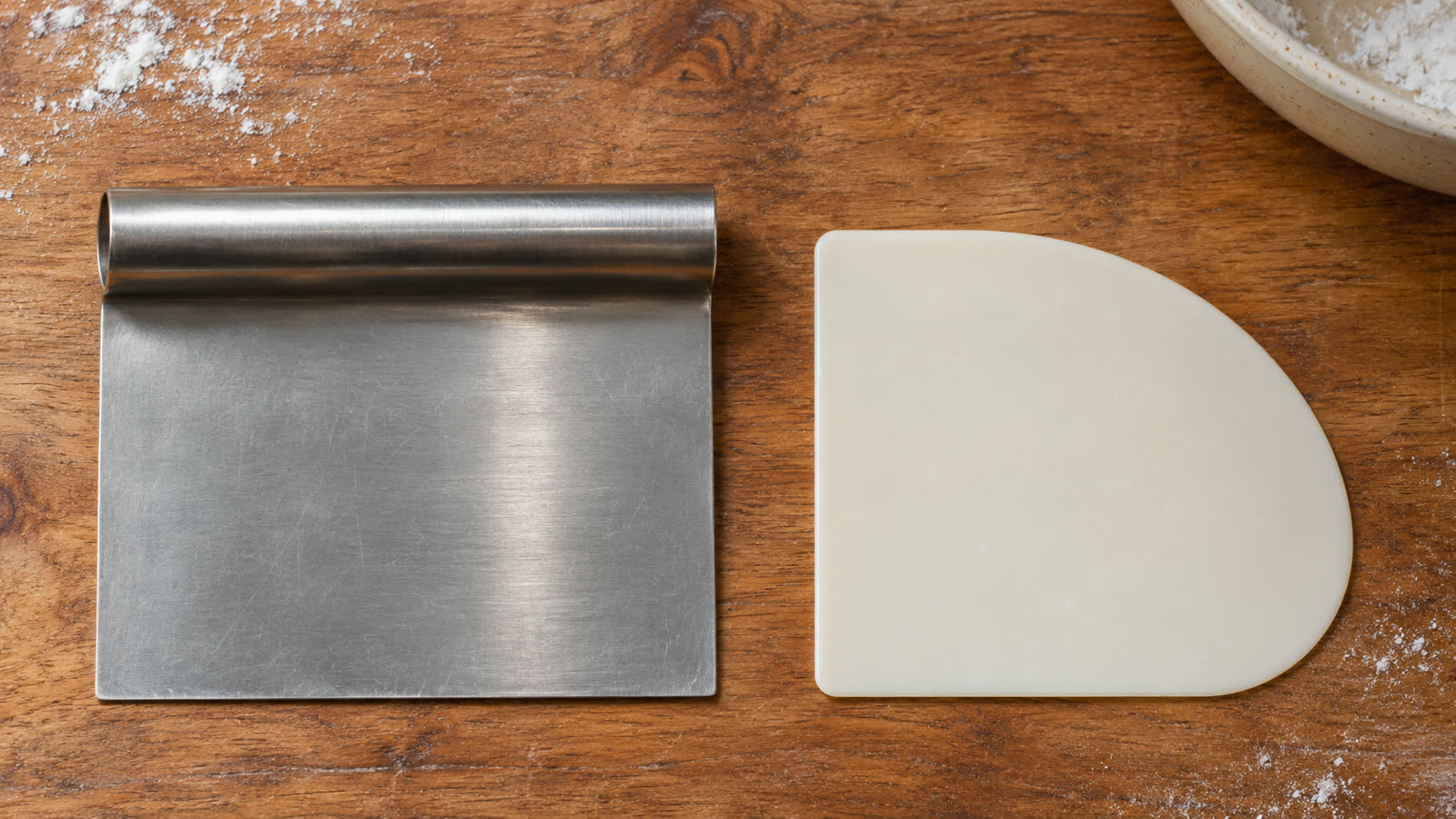
A bench scraper typically has a stiff rectangular metal blade, a straight bottom edge and a handle across the top. Its broad face supports pieces of dough from underneath. There are rigid plastic bench scrapers too. For a worktop or baking pan that marks easily, follow the surface maker’s guidance about compatible tools. A suitable cutting board gives you a place to use a metal edge. Avoid pressing a rough or damaged plastic edge against a delicate surface.
A flexible bowl scraper is usually a handleless card with a rounded side. The curve follows the wall of a mixing bowl, while the straight side can gather a soft dough on the counter. If you only have one scraper, think about the job you do most often. Choose a rigid straight edge for frequent portioning or a flexible curve for turning sticky dough out of bowls. Plastic tools vary in stiffness, so look at the shape of the working edge and feel how much it gives under pressure.
How to release sticky dough from a bowl
With one hand, tilt the bowl towards the board. Set the scraper’s curved edge against the wall just above the dough line. Slide down towards the base, then rotate the bowl slightly and repeat. Once one side is free, the dough will start to drop under its own weight. If a patch stays attached at the bottom, slip the scraper between the bowl and the dough and guide it onto the board. Work in shorter arcs in a deep bowl so you can keep the edge against the wall.
If dough sticks to the edge, slow down on the first pass and hold the scraper closer to the bowl. Passing through the dough leaves a film behind. If the curve of the scraper is too broad for a narrow base, use a smaller curve or a flexible spatula for that spot. To turn out risen dough in one piece, release the edges first, then tilt the bowl and support the dough from below. Following the wall reduces the stretching that happens when you pull upwards.
How to divide dough into even portions
Put the dough on a suitable cutting board and pat it into a roughly regular shape. Stand the straight edge upright where you want the cut. Press down once and lift the tool straight up. If a strand still joins the two pieces, press again on the same line. Pulling the scraper sideways drags the cut face of the dough out of shape.
For example, to make 8 sandwich rolls from 600 g of bread dough, aim for 75 g per piece. Divide the dough in half and cut each half into four rough portions. Weigh each piece and trim a little from any that are too heavy. Tuck the trimming underneath a lighter portion and incorporate it as you shape. If you portion a loaf dough such as this soft sandwich bread recipe into rolls, use the new size to judge shaping, final proof and time in the oven. The timing for the loaf pan does not carry directly over to small rolls.
How to lift and move dough without tearing it
For lifting, set the flat edge at a shallow angle to the board. Slip it under the piece with a short movement and transfer the weight onto the blade. Support a heavy or slack piece underneath with your free hand. If you cannot get under a sticky edge on the first try, approach from another side and free it in small sections. A single pass may lift a small roll. For a broad piece, freeing the perimeter first reduces sagging as you lift.
If dough wraps around the scraper edge, clear it off and make a shorter pass. A firm, dry dough and a loose, sticky dough behave differently. The rigid blade slides easily under the former. For the latter, support the piece without squeezing it between your fingers. Leave a little space between portions so you do not have to separate them again at the scale.
Cleaning up the worktop without gouging it
Gather loose flour and scraps into a pile. Keep the edge at a shallow angle, collect the residue and transfer it to a container. If a dried spot will not come away, soften it and wipe with a suitable cloth according to the worktop care instructions. Keep a metal edge away from coated bakeware. When washing and drying the scraper, check the edges and the junction of blade and handle. Replace a tool if a damaged working edge catches on the dough.
Clear the scraps before they dry. Once the rolls are on their tray, gather the dry flour first and then lift the sticky bits with short passes. Put the scraps in one container so wiping does not turn flour into paste and spread it over the worktop. If the rolls will go back onto a floured patch, clear that area last.
Sources
King Arthur Baking’s guide to bread tools · King Arthur Baking’s rigid plastic scraper examples
İyi Bir Yemek
Food Researcher & Writer
Reader Comments & Contributions
Be the first to share your thoughts on this post