
Guide to the Regions of Veal Meat: Which Piece Should Be Cooked How? (Butcher and Chef Guide)
What are the parts of meat in veal? In which dishes are entrecôte, tenderloin, sirloin, neck, breast and shank used? Comprehensive guide to cuts of beef for the grill, pot and oven.

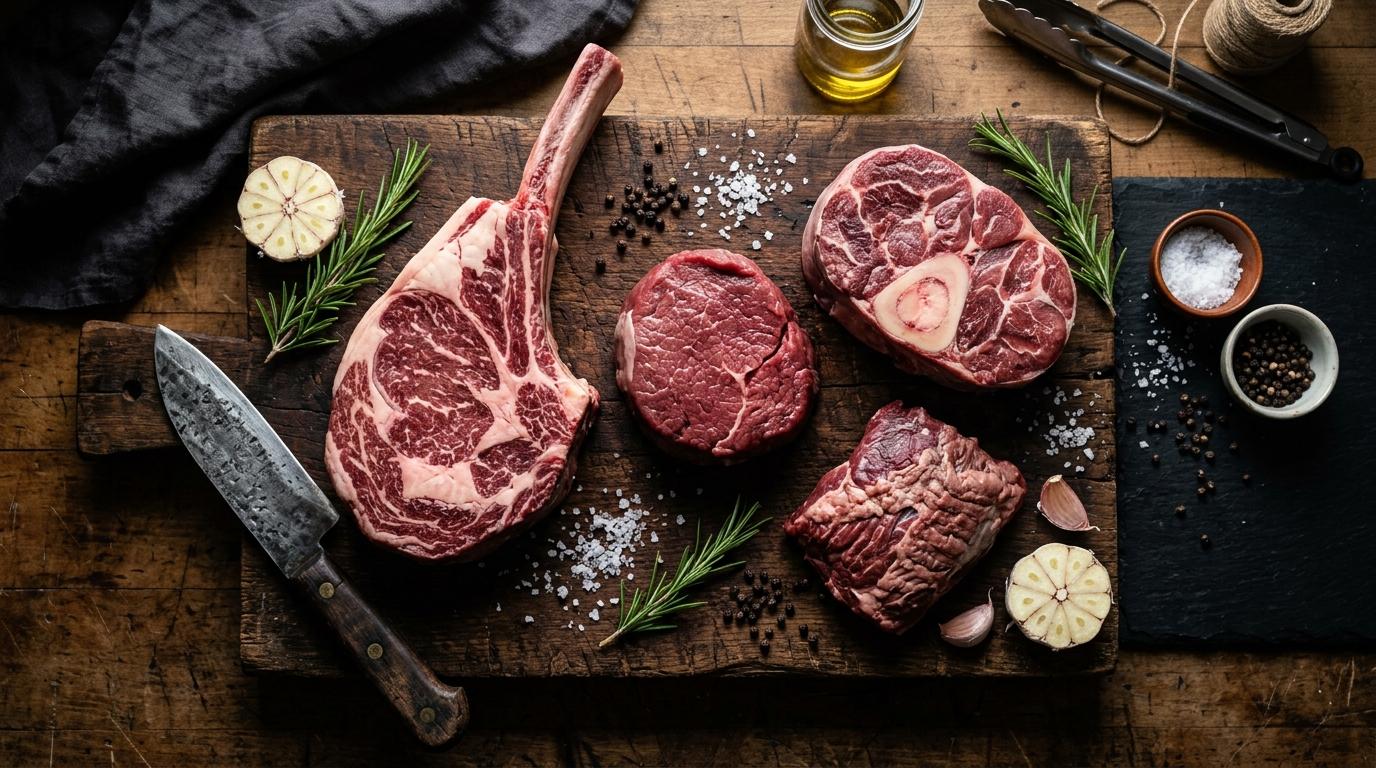
The first and most basic rule of achieving a professional taste in the kitchen is to know the anatomy of the meat that goes into the pan or pot. Even if you buy the best quality meat in the world, if you try to quickly grill a collagenous piece that requires heavy baking in a cast iron pan, it will dry out and become hard; Similarly, if you boil a lean and delicate tenderloin in a pot for hours, it will lose all its elegance. In this guide, we examine all meat parts of the beef, from the butcher's counter to the plate, its flavor characters and correct cooking techniques, step by step.
Basic Gastronomy Rule: Muscle Movement and Collagen Balance
There is only one golden rule in cattle anatomy that determines the texture of meat:
- Hard Working Muscles (Neck, legs, jaw, chest):These muscles, which carry the entire weight of the animal and enable it to walk and chew, have tight fibers and rich connective tissue (collagen) contains. These items are not suitable for high heat grilling; It requires long-term cooking (braising, boiling, stewing) in a moist, closed and low temperature environment. When they are cooked patiently, the collagen turns into silky gelatin and the meat falls apart like Turkish delight.
- Underactive Muscles (Back and waist area):These muscles, which remain on the animal's body, almost do not move. Its fibers are delicate and its tissues are soft. It should be consumed by sealing the outside and leaving the inside juicy (rare or medium rare) using dry and high-heat rapid cooking techniques (cast pan, barbecue, grill).
1. Head and Neck Area: Storehouse of Collagen and Flavor
Neck
It is the neck part of the calf. Because it is in constant motion, muscle fibers are thick and contain dense connective tissue. The balance of fat and meat is quite rich.
- How to Cook:It is perfect for slow cooker dishes (tas kebab, meat and vegetable dishes), rich broths, soups and minced meat. When cooked patiently over low heat, it gives the broth a unique consistency.
Beef Cheek
It is arguably the hardest-working muscle of the body, as the calf chews the cud. Although seemingly tough and fibrous, it is one of the most valuable treasures of professional gastronomy.
- How to Cook: Braising (sealed baking over low heat)He is the master of his technique. When cooked in the oven at 140°C with vegetables and bone marrow broth for 4 hours, it acquires a silky texture that separates into fibers. We have prepared this unique experienceSlow Roasted Beef CheekYou can review our recipe step by step.
2. Back and Loin Region: The Most Valuable Steak Cuts
Ribeye
It originates from the part of the calf's back spine at chest level (approximately between the 6th and 12th ribs). The trademark of the entrecôte is the marble-like fat veins (marbling) distributed homogeneously within the meat tissue. These internal fats, which melt while cooking, add incredible juiciness and deep flavor to the meat.
- How to Cook:It should be quickly seared over high heat in a very hot cast iron skillet or grill. In order not to dry the meat, it is recommended to cook it at medium-rare or medium temperature. It should never be placed in potted food.
Tenderloin (Tenderloin / Filet Mignon)
It is a long cylindrical muscle located in the kidney bed, hidden on the inside of the calf's back spine. The animal almost never uses this muscle. Therefore believeIt is the softest, most delicate meat.. Its fat content is very low compared to entrecôte.
- How to Cook:It should be cooked very little; If it is overcooked, it will dry out immediately because it is oil-free and its fibers will become felt-like. After the exterior is quickly sealed over high heat, butter, fresh garlic and rosemary are added to the pan, the meat is fed with a spoon (basting) and served at medium-rare temperature.
Sirloin (Striploin / New York Strip)
It is the loin meat that extends towards the coccyx, just after the entrecôte on the back of the calf. There is a thick strip of fat on the outer edge, but the inside of the meat is less marbled than the ribeye. It has a firmer bite than ribeye and a more intense meat flavor than tenderloin.
- How to Cook:In the cast iron grill pan, the fat strip on the edge is kept upright and the fat is first crisped, then both surfaces are sealed and sliced.
T-Bone and Porterhouse
It is a favorite of meat lovers with bones. delicate on one side of the T-shaped spine bonetenderloin, aromatic on the other sidesirloinis available. It offers two different textures and flavors in a single cut. The bone preserves the juices of the meat and adds extra flavor while cooking.
3. Chest and Lower Abdomen: Oily and Aromatic
Breast (Brisket & Plate)
It is the area under the chest and front belly of the calf. It is a fibrous, muscular and quite fatty piece. It has a very high taste.
- How to Cook:It is the main backbone of the perfect meatball, burger meatball and lahmacun filling. Since the oil content is ideal (20-25%), it does not cause drying. It is also marinated and smoked as a whole piece (Texas style brisket) and turned into Turkish delight in 10-12 hours.
Short Ribs
It is a magnificent piece with bones, dense fat and collagen. The rich tissue where bone and meat meet, comes off the bone when cooked slowly in the oven.
4. Leg Area: Lean, Tight and Characteristic
The leg area, which forms the upper part of the calf's hind legs, consists of lean and tight muscle groups:
- Nuar (Eye of Round):It is a fat-free, nerveless and round cylindrical piece. Since it is oil-free, it is not suitable for grilling; The classic, which is sealed like a pomegranate and cooked in the oven over low heat.roast beefIt is indispensable for construction.
- Counternumber (Flat):It is located right next to Nuar. It is suitable for sauce pot steak, meat stews and tas kebab.
- Tranch (Topside):It is the largest and softest inner part of the drumstick. It is ideal for Austrian style schnitzel (Schnitzel), which is prepared by frying, sautéing and finely pounding fat-free cubes.
- Sokum (Rump):It is the softest part at the top of the leg, adjacent to the sirloin. It can be grilled as a steak or cooked as a Turkish delight shish kebab.
5. Shank (Shank / Osso Buco)
These are the leg parts of the calf below the knee joint. Since leg muscles are constantly working, they contain dense nerve and connective tissue; but it carries a rich marrow bone in its middle.
- How to Cook:Italians are famousOsso BucoIt is the main ingredient of the dish. When it is sealed in a pot and baked with wine, bone broth and root vegetables, the marrow melts and the meat has a jelly-like consistency and falls apart when touched by a fork.
Summary: Which cooking method for which piece?
| Piece of Meat | Fat & Texture Feature | Ideal Cooking Method |
|---|---|---|
| ribeye | High marble oil, soft texture | Cast iron pan, barbecue, grill (Medium-Low) |
| Tenderloin | Oil-free, extremely delicate and soft | Quick pan searing, butter basting (Low/Medium-Low) |
| Double Filet & T-Bone | Firm and aromatic texture with an oily edge | Grill, cast iron pan |
| Beef Cheek & Shank | Very high collagen, tough fibers, marrow | Braising, oven off, casserole (low heat for 3-4 hours) |
| Brisket | Fibrous, densely flavored and fatty | Burger/meatball minced meat, smoking, heavy baking |
| Dewlap | Medium fat, fiber and collagen | Casserole dish, bowl kebab, soup, boiled |
| Nuar & Tranç | Fat-free, firm and avascular tissue | Roast slices, schnitzel, sauteed in the oven |
3 Golden Butcher Tips from Master Chefs
- Never Throw Meat into the Pan Straight Out of the Refrigerator:When cold meat enters a hot pan, it instantly lowers the temperature of the pan, releasing its water and boiling instead of being sealed. Let it come to room temperature for at least 30-40 minutes before cooking.
- Salting Timing:Salt thick cuts of steak with plenty of coarse sea salt just before cooking. Salting too early draws the juices out of the meat due to osmosis.
- Resting After Cooking:Do not cut the meat immediately after it comes off the grill. Let the meat rest on a warm board for 5 to 8 minutes, depending on the thickness of the meat, so that the juices collected in the center of the meat during cooking are distributed homogeneously throughout the fibers.
İyi Bir Yemek
Food Researcher & Writer
Reader Comments & Contributions
Be the first to share your thoughts on this post