
Why Do Oil and Vinegar Separate in Salad Dressing?
See why oil and vinegar separate. Compare whisking, shaking and adding Dijon with the same ratio, then learn how to bring a split dressing back together.

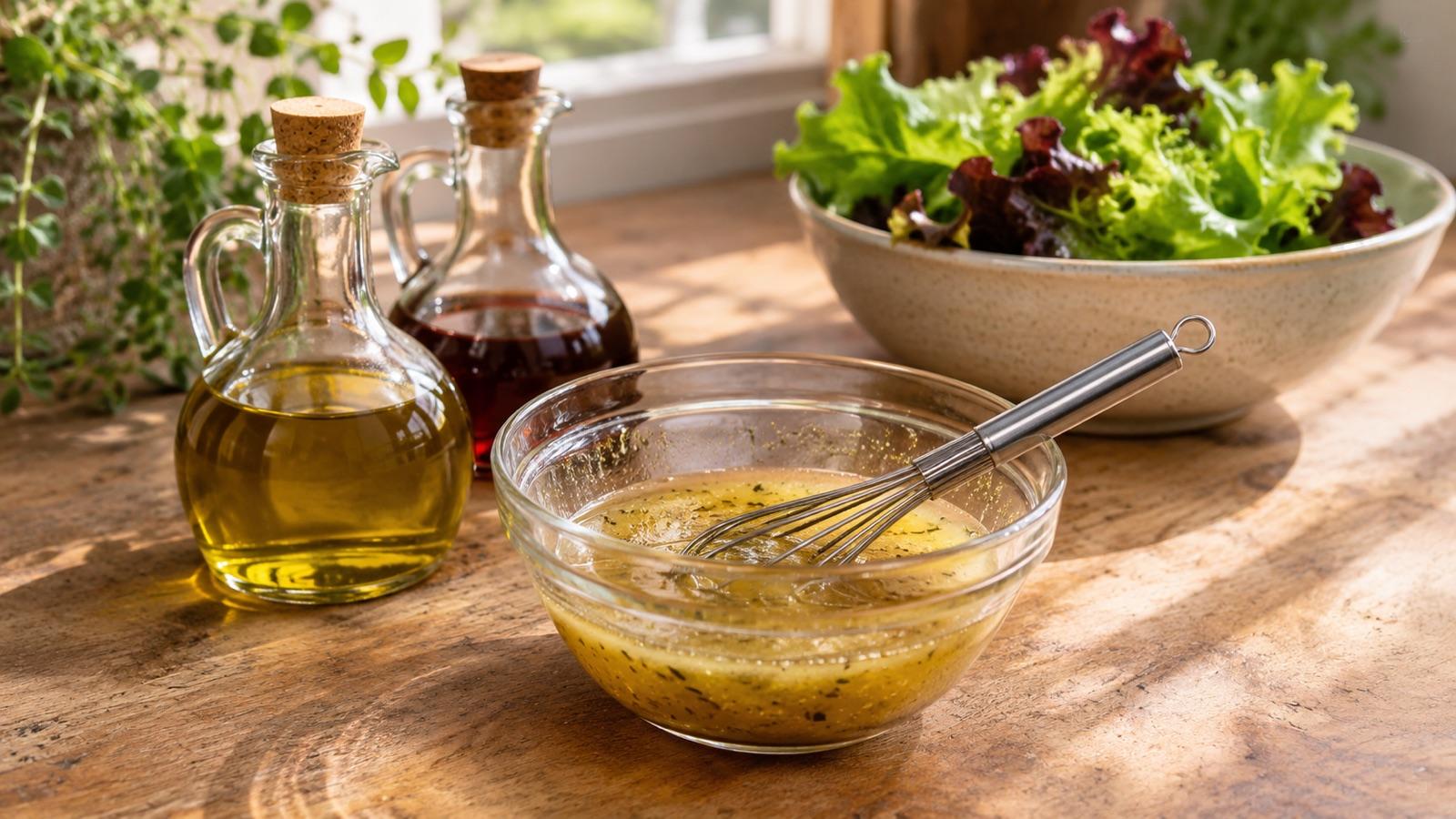
Oil and vinegar separate because oil does not dissolve in the water in vinegar. Whisking or shaking breaks the oil into tiny droplets and disperses them for a time. Smooth mustard can help that dispersion last longer. A quick shake is often enough if you are serving straight away. If the dressing is going to the table separately, watch for layers and mix again before pouring.
How the layers form
In unmixed vinaigrette the oil sits on top and vinegar underneath. The less dense oil rises. A whisk or a spell of shaking breaks it into small droplets. The droplets scatter light, so the dressing looks paler and cloudy. Once the mixing stops, droplets gradually rise, merge and form a distinct layer of oil again. A clear surface is particularly easy to see if you hold a jar against a plain background.
Mustard can slow down the droplets joining back together. A small amount of smooth Dijon is easy to distribute evenly in the vinegar. The type and amount of mustard, the oil-to-vinegar ratio, the mixing method and the waiting time all affect what you see. A narrow, shiny line may appear at the top while the bottom is still cloudy. Distinguish that stage from two fully separate layers with a clear boundary. Appearance gives you a clue to how thoroughly mixed the dressing still is.
Indiana Department of Education — Culinary Skills Manual
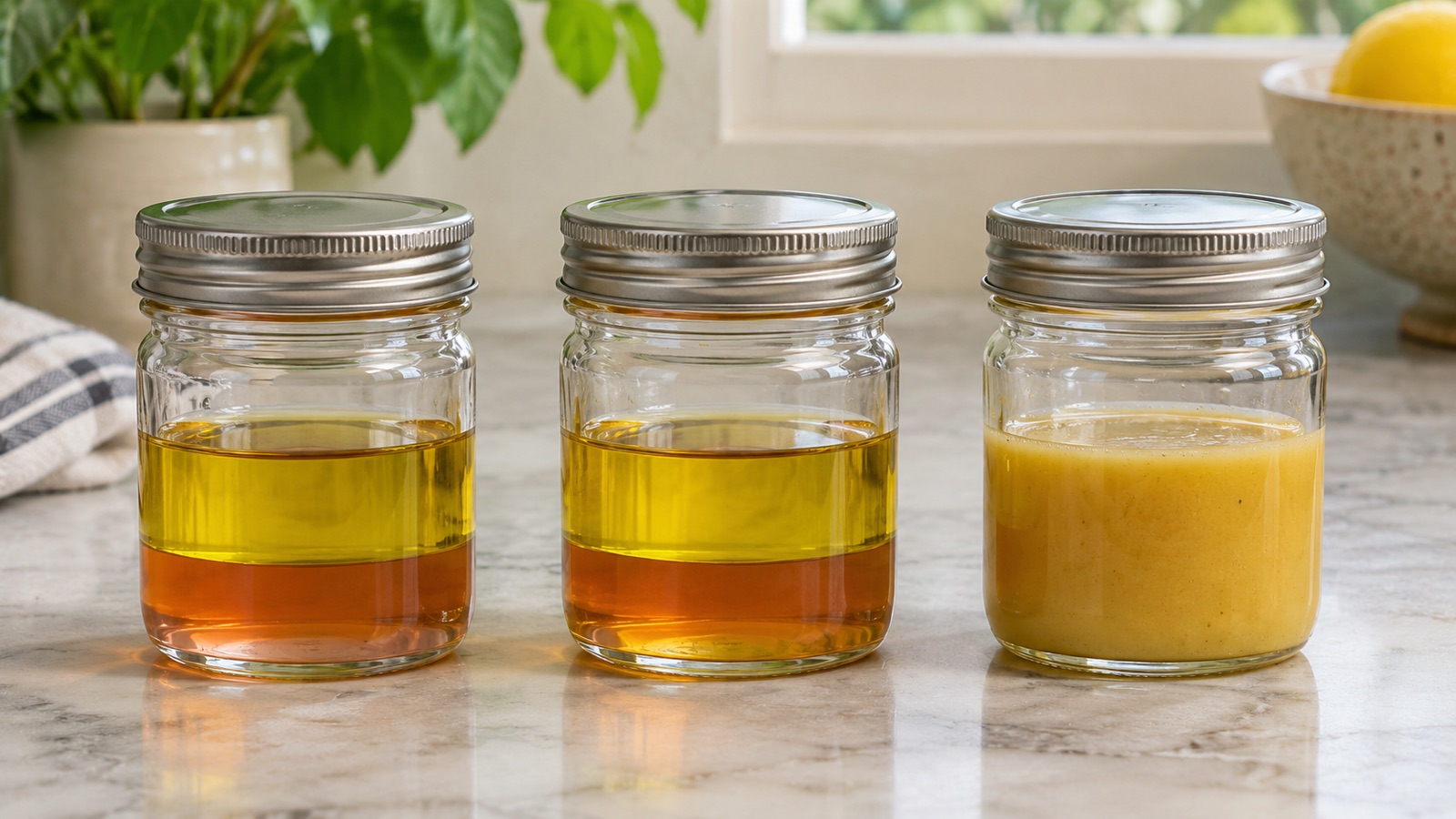
Compare three methods at the same ratio
For each sample measure 45 ml oil and 15 ml vinegar from the same bottles. For the first, put the vinegar in a small bowl and whisk for 20 seconds as you trickle in the oil. For the second, put both into a lidded jar and shake for 20 seconds. For the third, mix 5 ml smooth Dijon into the vinegar and whisk in the oil for 20 seconds as in the first sample. Transfer the whisked dressings to matching clear jars. Record their appearance as soon as mixing stops.
Stand all the jars on a level surface in the same light, with space between them. After 2 and 5 minutes for each, look for a clear layer at the top without disturbing the jar and note its depth. Save salt, honey and herbs until the comparison is over. You may see separation in the first two and longer-lasting cloudiness in the mustard sample. Vigour of mixing and motion during transfer can affect the result. Use the times as shared observation points for a kitchen comparison.
Government of Alberta — Fun with Foods Activity Guide
When to whisk and when to shake
For a leafy salad served right away, a clean jar with a tight lid is enough. Leave room for the liquid to move. Secure the lid, shake, drizzle a little on some of the leaves and taste. Leaves still wet from washing will dilute the dressing and send it to the bottom of the bowl. Drain and dry them and dress them when you are ready to eat.
A bowl and whisk give you a view of the oil as you add it. Whisk the mustard into the vinegar first. Then add the oil in a thin stream while whisking. A slow pour helps prevent it from collecting in one spot. Use a narrow-bottomed bowl for a small batch so that the whisk can reach the liquid. For a warm potato salad add a little mixed dressing, toss, and see how much has coated the potatoes before deciding how much more to use.
Bring a split dressing back together
If oil has collected at the top of a jar, close the lid and shake just before pouring. If a ring of oil has developed in a bowl, whisk again, reaching right to the bottom. If you poured all the oil in at once and left a large layer over a mustard dressing, start over in a clean small bowl with a spoonful of the vinegar-rich liquid underneath. Add the rest gradually while whisking constantly. This lets you rebuild the mixture starting with a small volume.
If salting the dressing, dissolve the salt in the vinegar first. If the oil dominates, move a spoonful of dressing to a separate plate before adjusting the whole bowl. Add a few drops of vinegar and taste on a leaf. If you like the result, make the same change gradually to the main batch. If it is too sharp on the leaf, whisk in a little more oil. Make changes for texture and flavour one at a time so you can see what each does.
Adjust the dressing to the dish
Three parts oil to one part vinegar is a starting point. A sharp wine vinegar can taste quite different from the same amount of mild rice vinegar. For seasoned rice vinegar check the label for salt and sugar, then taste before adding either. Mustard can bring salt and pungency of its own. If you would prefer a plain dressing, mix it right before serving. Taste on a small handful of greens to see how the dressing will work in the dish.
For a substantial salad such as cooked lentils, dress in two passes. Toss after the first addition and look for liquid collecting underneath. If the bottom tastes very acidic while the top tastes oily, shake the dressing again before pouring in any more. If the lentils are evenly coated, serve the remaining dressing separately at the table. This lets you control the amount in a small salad bowl or on a large platter passed around the table.
If you repeat the comparison, change just one thing first. For example, use the same oil and mustard with wine vinegar in one batch and rice vinegar in another. Keep the mixing method and observation times. This lets you judge sharpness on the palate separately from the separation visible at the top of the jar.
For help choosing a bottle, see plain versus seasoned rice vinegar.
İyi Bir Yemek
Food Researcher & Writer
Reader Comments & Contributions
Be the first to share your thoughts on this post