
How to Tell Whether a Pan Works on Induction
Check the magnet response, actual base diameter and hob instructions together before replacing cookware or choosing a pan for induction.

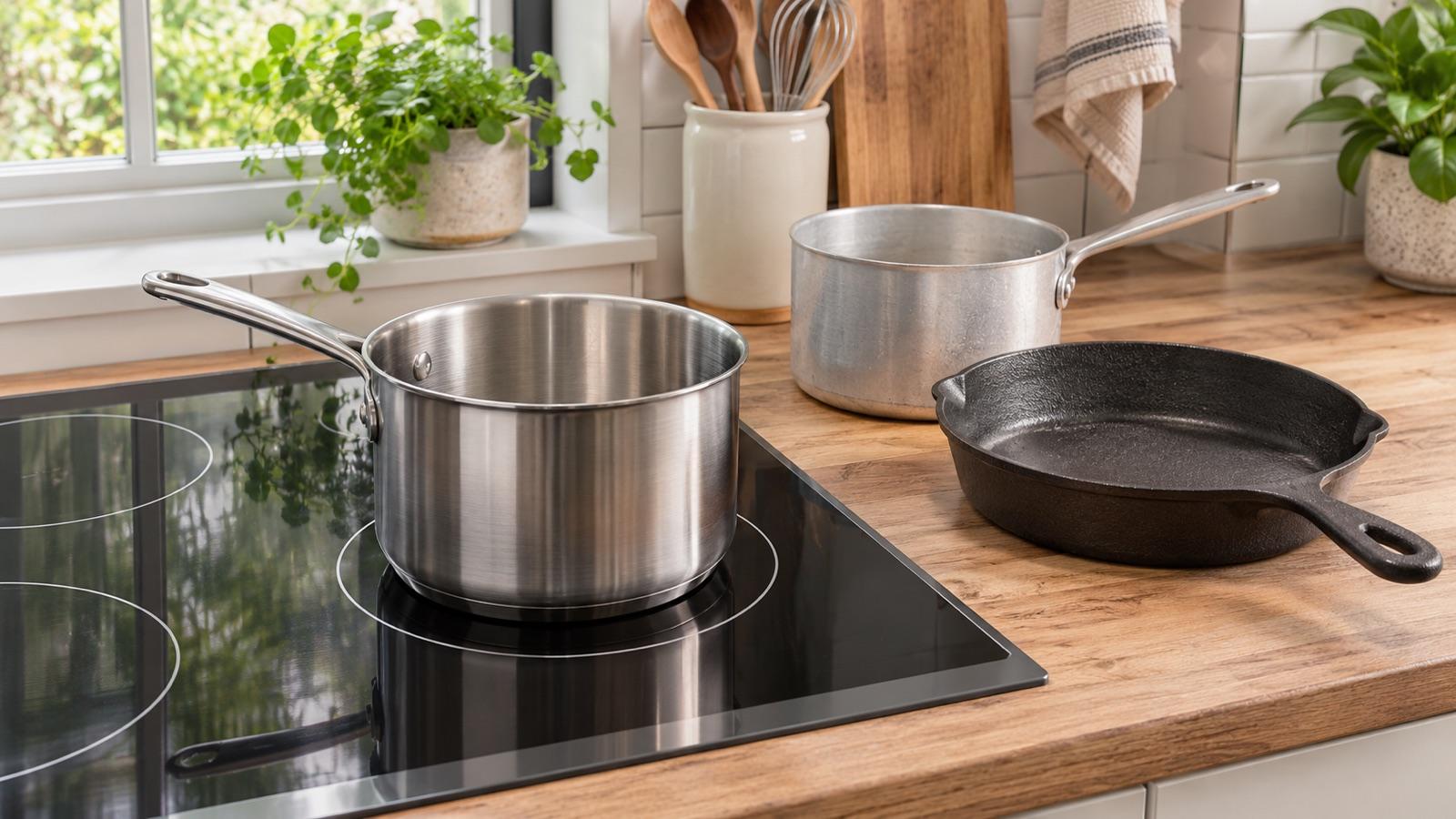
Start with a magnet on the pan base, then compare its dimensions with your hob manual. Attraction is an initial screening check, not a guarantee of good performance on every zone. Use this guide to assess existing pans and ask useful questions when shopping.
Check the base before trusting the label
With the hob off and cookware completely cool, move the pan onto the counter. Offer a small magnet to the centre and several points closer to the base edge. Test the underside facing the hob, rather than the side wall. An aluminium body may work when it has a suitable attached base, while shiny stainless steel alone proves nothing. Look for a written induction compatibility statement and the manufacturer's conditions. A magnet cannot assess the coating or tell you whether the handle is oven safe.
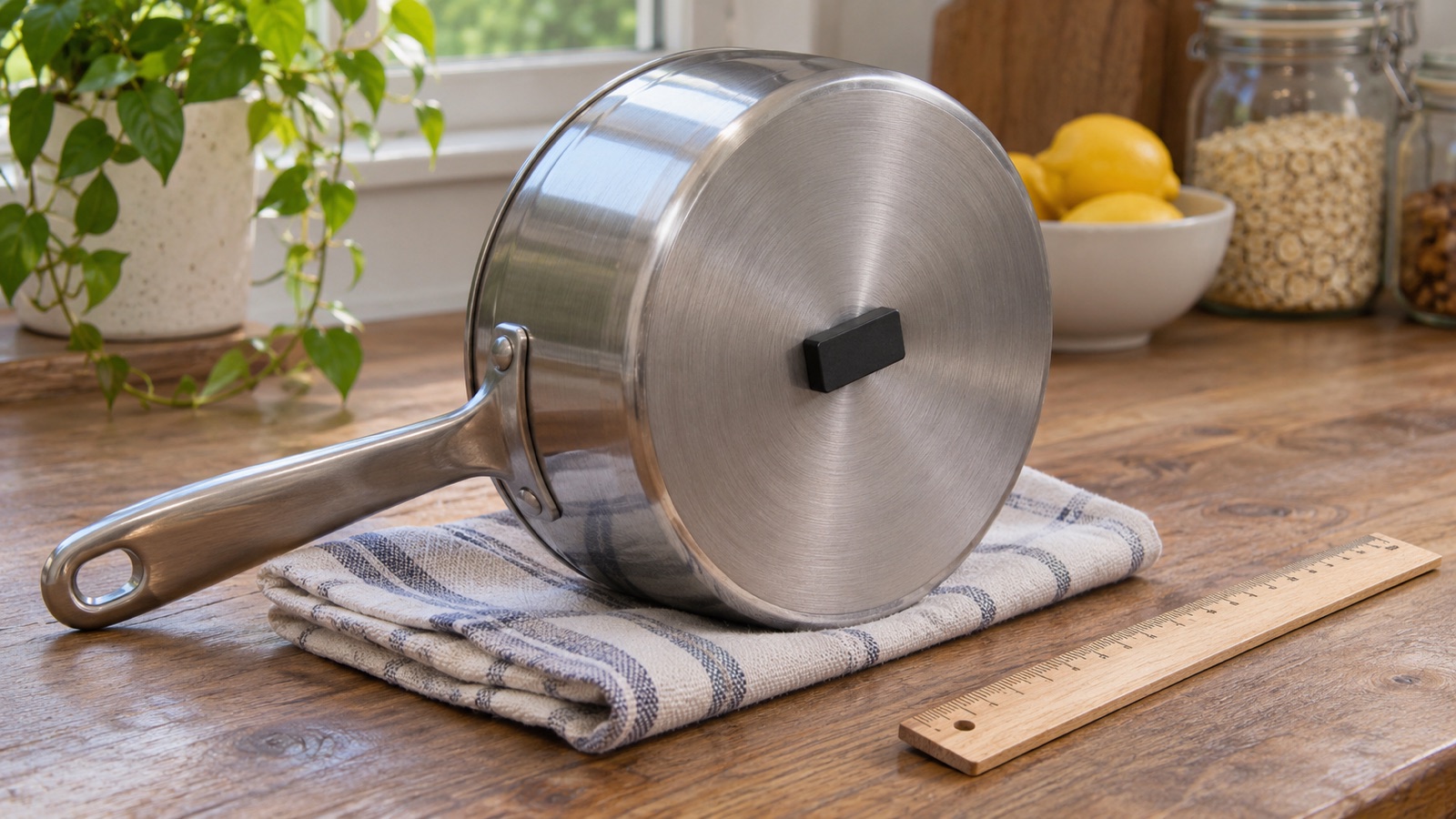
Make a simple inventory: marked size, actual base diameter, magnetic response and manufacturer marking. Examine the lid too, but do not use it for the magnetic test. If attraction is limited to a small central disc, record that rather than assuming the entire base will heat alike. There is no need to switch the hob on for this check. The photograph illustrates a cold check, not a measured performance result.
Measure the base, not the rim
A pan advertised as 24 cm need not have a 24 cm base. Suppose the rim is 24 cm and the base 18 cm: use the measurement specified for the base when comparing with the manual. These are illustrative figures, not universal limits. Measure across the flat underside from edge to opposite edge, excluding the sloping walls. If a manufacturer drawing identifies the magnetic area separately, record it too.
If a small sauce pan is not detected on a large zone, do not immediately conclude that it is faulty. Use an allowed smaller zone and centre the pan. Conversely, a broad frying pan can still have a small magnetic disc; the wide rim does not resolve that limitation. Bridge and flexible zones require the positioning and activation procedure in their own manual. There is no minimum diameter or layout valid for every hob.
Read material names alongside practical needs
Cast iron, suitable steel and induction based multilayer cookware are candidates. Plain glass, copper or aluminium should not be assumed compatible without a suitable magnetic base. Cast iron, enamelled iron and stainless steel also have different care requirements. Before buying, consider whether you can lift the empty pan comfortably, grip the handle and fit the filled pan in the space available. Compatibility alone does not make a heavy pot convenient.
For a daily milk sauce, you might choose a small pan that pours comfortably; for vegetables, a frying pan with useful flat base area. Cross-check both choices against permitted hob dimensions. You need not replace an entire set if existing pieces work. A coating says nothing about whether the base is magnetic. Even sizes within one range may differ, so request the technical information for the exact size you intend to buy.
Do not make the first trial with an empty pan
After checking compatibility and the manual, follow any dedicated cookware test exactly as the manufacturer describes it. For a general observation, centre a pan containing water on a suitable zone and watch it heat. This is not a laboratory test and promises no particular boiling time. Stay present; do not heat an empty vessel at maximum power. Water quantity, starting temperature and power setting affect the result, so unequal conditions cannot fairly rank two pans by speed.
For the next actual use, choose a familiar simple task such as heating water or making a sauce. Observe detection, overflow and sticking as separate issues. Do not translate a gas knob position directly into an induction power level. Switch the hob off using its controls afterwards; removing the pan is not a universal substitute. Keep base and hob dry. Do not touch the glass to check temperature; heed the residual heat indicator.
Bosch · PXX...HC.. manual, sections 2, 4, 5, 21
Troubleshoot in a useful order
Check the selected zone, centring, clean dry base and permitted diameter first. Then try another pan that its manufacturer identifies as compatible on the same zone. If only one pan fails, revisit its base; if several suitable pans fail, record the error code and contact appliance support. Do not open the appliance or alter electrical connections. This sequence helps avoid buying cookware to solve an unrelated fault.
A sticking magnet does not overrule an unsuitable diameter or limited magnetic area. Nor is an adapter disc an automatic remedy: the Bosch manual cited here prohibits adapter plates. Your own appliance instructions govern. Take the base measurement and hob model when shopping and request written compatibility information for the exact product. For care choices after compatibility is established, consult the linked cast iron guide.
İyi Bir Yemek
Food Researcher & Writer
Reader Comments & Contributions
Be the first to share your thoughts on this post