
How to Reheat Food Uniformly in a Microwave: Watts, Power and Resting Time
Why is a microwave meal hot at the edge and cold in the middle? Learn to use output watts, shallow dishes, stirring and standing time together.

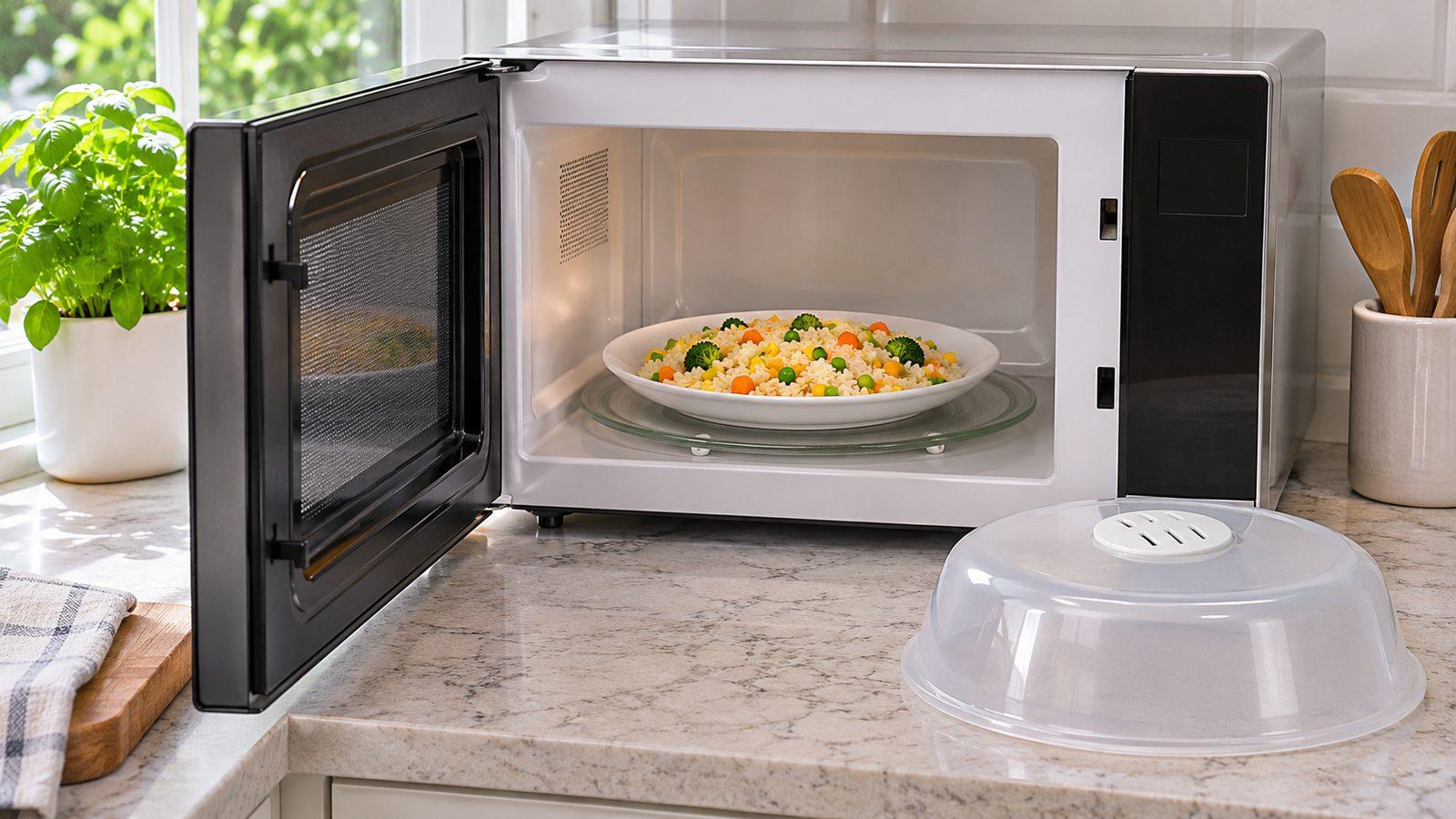
To reheat food uniformly in a microwave, you need to do more than increase the heating time: spread food in a shallow microwave-safe dish, cover with a steam vent, redistribute it during heating, then allow the instructed standing time. Check leftovers with a food thermometer in several places for at least 74°C (165°F). A hot plate or visible steam alone cannot confirm that its centre is ready. This guide concerns previously cooked, properly stored food; raw-food cooking and defrosting require their own instructions.
Find output watts before choosing a power percentage
Look for microwave output in watts in the appliance manual or on its label. Electrical input consumption is a different figure: do not copy the larger number into a cooking instruction. A package designed for an 800 W microwave may need adjustment in a different appliance; use its stated alternatives where available. The exact model manual takes priority over an online conversion chart. Keep a simple note of output wattage near the appliance so another household member can check it without guessing.
A power percentage describes the selected setting, not a measured food temperature. For a hypothetical 1000 W output appliance, 50% corresponds to a nominal average of about 500 W, not a guarantee of identical heating to a separate 500 W model. Some appliances cycle full power on and off; inverter models may regulate differently. Consult the manual. When edges dry while the centre lags, a lower setting with more redistribution may help. It cannot replace a final temperature check.
Virginia Tech · Microwave technology
Choose the container and spread the food
Use a dish and cover explicitly marked or documented as microwave-safe, with no metallic decoration. A glass or ceramic appearance alone is insufficient. Transfer take-away food out of packaging unless that packaging is approved for the intended use; a single-use tray is not a permanent reheating dish. Check cracks and the turntable clearance. Arrange a normal serving in a shallow layer instead of a compact mound. A deep cup of thick puree and a wide bowl of the same amount will not behave alike.
For example, loosen a serving of cooked rice and vegetables rather than leaving it as a cold block. Spread it evenly, with a shallower centre, and separate large clumps. With pieces of different size, place thicker ones toward the outside and keep the layer as even as practical. This is a starting arrangement, not a universal promise about where every oven heats fastest. Put on a microwave-safe cover with a small steam outlet; do not seal the container airtight. A lid reduces drying and splashes while permitting steam to escape.
Health Canada · Microwave food safety
Heat, stop and redistribute deliberately
Start with the package or appliance guidance for the actual food and quantity. Stir the food when the instructions say to stir it; for an unpackaged leftover, interrupt heating to inspect and redistribute rather than running one long uninterrupted cycle. Use an oven mitt where necessary. Move food from the outer edge toward the centre and bring the centre outward, then break up remaining clumps. Turn larger pieces over when appropriate. Replace the vented cover before continuing. A turning glass plate changes position, but it does not mix the food for you.
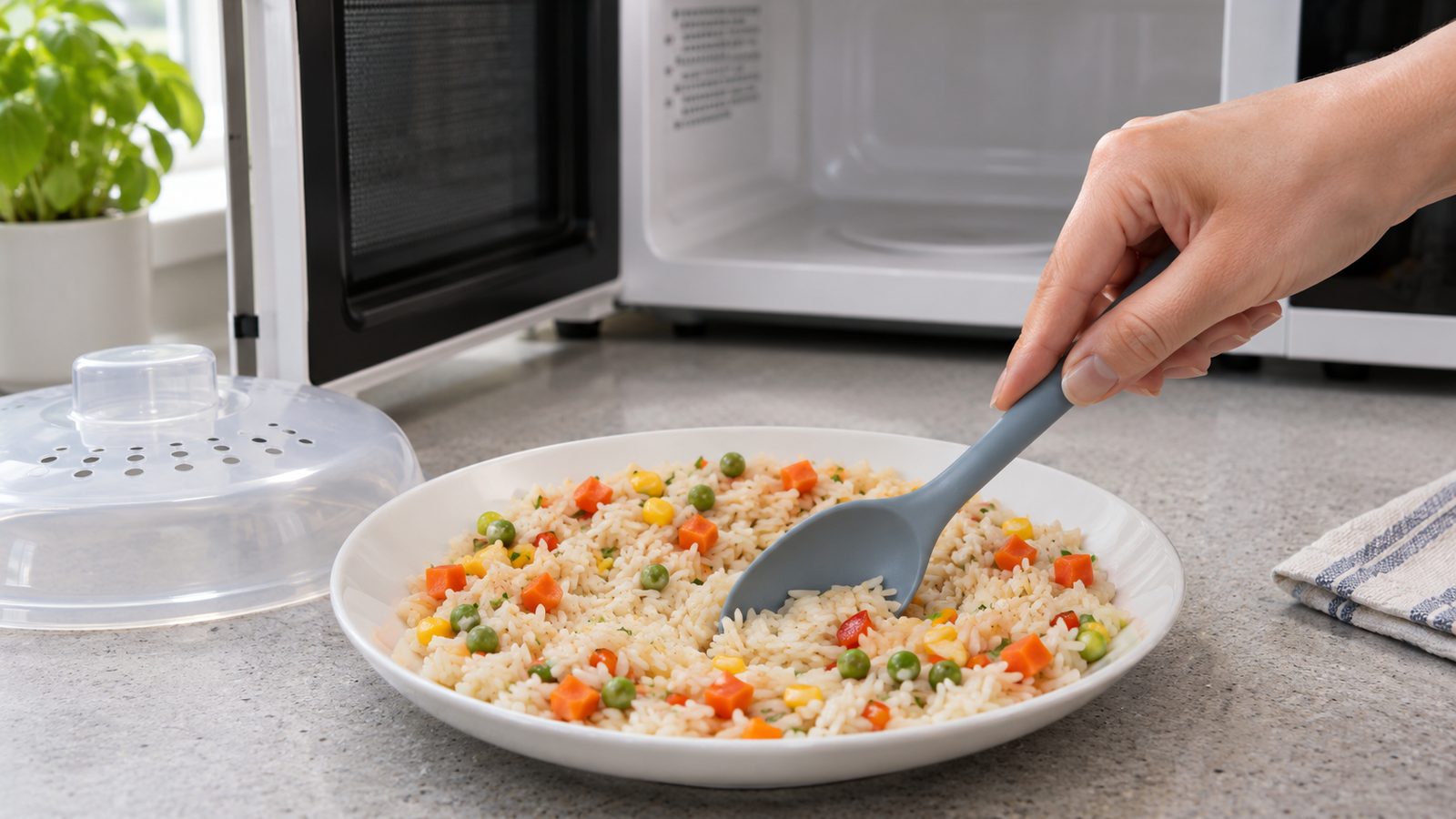
If a thick soup bubbles at one edge while another area remains lukewarm, stop and stir the whole volume, including the bottom. Resume in short monitored stages instead of doubling a familiar timer. Reheating two servings in one deep bowl is not the same task as reheating one; dividing them into shallow portions can make checks easier. Record food amount, dish and setting together if you want a repeatable household routine. No fixed number of seconds in this guide guarantees safety across appliances or starting temperatures.
Health Canada · Microwave food safety
Treat standing time as part of the process
After the heating cycle, leave food covered for the standing time specified on the package or in the relevant appliance guidance. This interval allows heat to redistribute; it is not just time to set the table. Where no standing time is supplied, consult the model guidance rather than inventing one universal value. Keep the food in its dish and avoid uncovering it prematurely merely because the timer has sounded. Then open the cover away from your face and hands because trapped steam can burn.
After standing, check leftovers in several places, including the centre and thickest pieces, with a clean food thermometer. Check that every tested area reaches at least 74°C (165°F); keep the probe away from the dish and bones. If a spot is cooler, stir or turn as appropriate, continue heating and repeat the standing and checking process. One high temperature reading at the edge does not prove that all the food is hot enough. Remove the thermometer before starting the microwave. Only use a thermometer inside a running microwave if both manufacturers explicitly allow this. Reheating does not rescue food that was stored unsafely.
FDA · Cooking and standing time · Health Canada · Microwave food safety
Troubleshoot without turning up every setting
Dry edges with a cold centre suggest a thick layer, poor redistribution or an overly aggressive cycle. Try a shallower dish, a vented cover and a pause to stir; change one variable at a time. Splattering suggests a need to reduce intensity and inspect the cover vent, not to seal the lid. A hot container with cool food calls for a check of container suitability as well as the food distribution. Stop if a container deforms or the appliance behaves abnormally, and follow the manufacturer’s directions.
Liquids deserve separate caution. Plain water can become superheated without obvious boiling and erupt when disturbed, as the FDA warns. Do not extend heating indefinitely because the cup looks calm; obey the model’s liquid-heating limits and handling instructions. Do not improvise a boiling-water calibration test. For everyday practice, keep a short checklist: correct output setting, suitable vented dish, shallow portion, redistribution, standing and several temperature readings. If you lack a thermometer, steam and touch still cannot demonstrate that a leftover reached the stated temperature.
Read the guide to aluminium foil and appliance compatibility
İyi Bir Yemek
Food Researcher & Writer
Reader Comments & Contributions
Be the first to share your thoughts on this post