
When Should You Use Aluminum Foil? Food Contact and Appliance Compatibility
Choose aluminum foil by food contact and appliance instructions: acidic or salty foods, shiny and dull sides, oven coverings and storage alternatives.

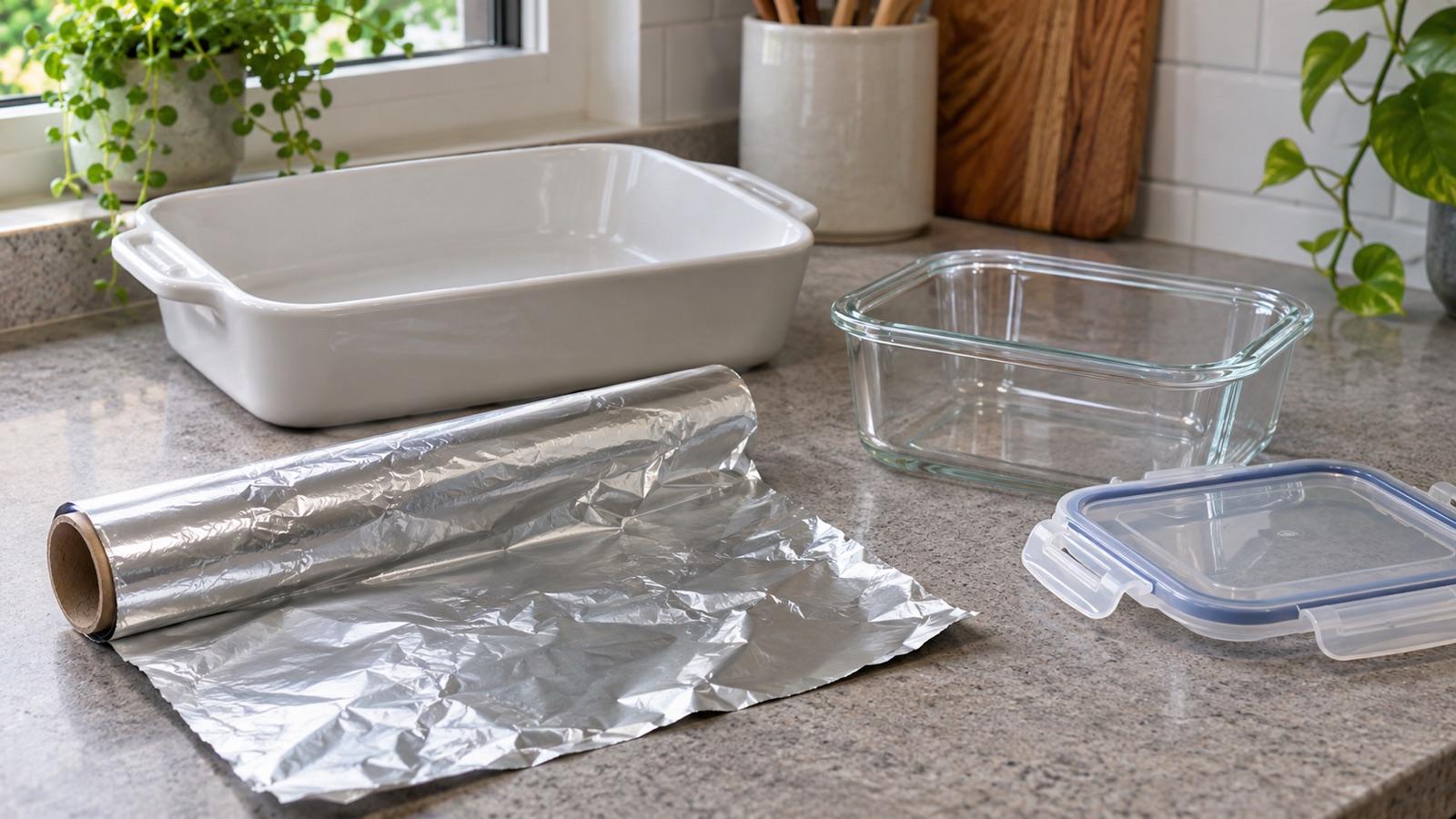
Aluminum foil is useful for covering some containers and suitable baking applications; It is not suitable as a direct wrapper for every food. Answer three questions first: Is the food acidic or salty, will the foil touch it, do the appliance and product instructions allow this use? Avoid direct contact with acidic and salty foods; Start with a glass or suitable ceramic container. Choosing the shiny side does not replace these decisions. The following guide distinguishes ordinary, uncoated household foil from specially coated products, making everyday kitchen decisions easier.
Assess the food and whether it will touch the foil
Make your foil selection by looking at the surface of the dish rather than its name. A lemon sauce, tomato mixture, pickled cheese or salty marinade should not touch uncoated aluminum directly. The German Federal Institute for Risk Assessment recommends avoiding this contact, stating that acid and salt can increase the dissolution of aluminum. This information is not enough to calculate how much aluminum will migrate into a particular dish over a given time. Do not create a universal safe contact time or temperature limit for every product that can be used at home.
Consider the ingredients before you start the preparation: Putting the tomatoes and vegetables in a glass baking dish solves the direct contact problem from the beginning; However, the container must also be suitable for the oven. If it is necessary to cover it, it is easier to choose a cover suitable for that container and device. If using foil is approved, leave space where it does not touch the food; Take into account that contact may occur due to splashing of liquid. Adding lemon afterwards does not automatically make a previously salted dish suitable for foiling. Food restrictions on the product packaging apply in all cases.
Compare foil with lid for storage
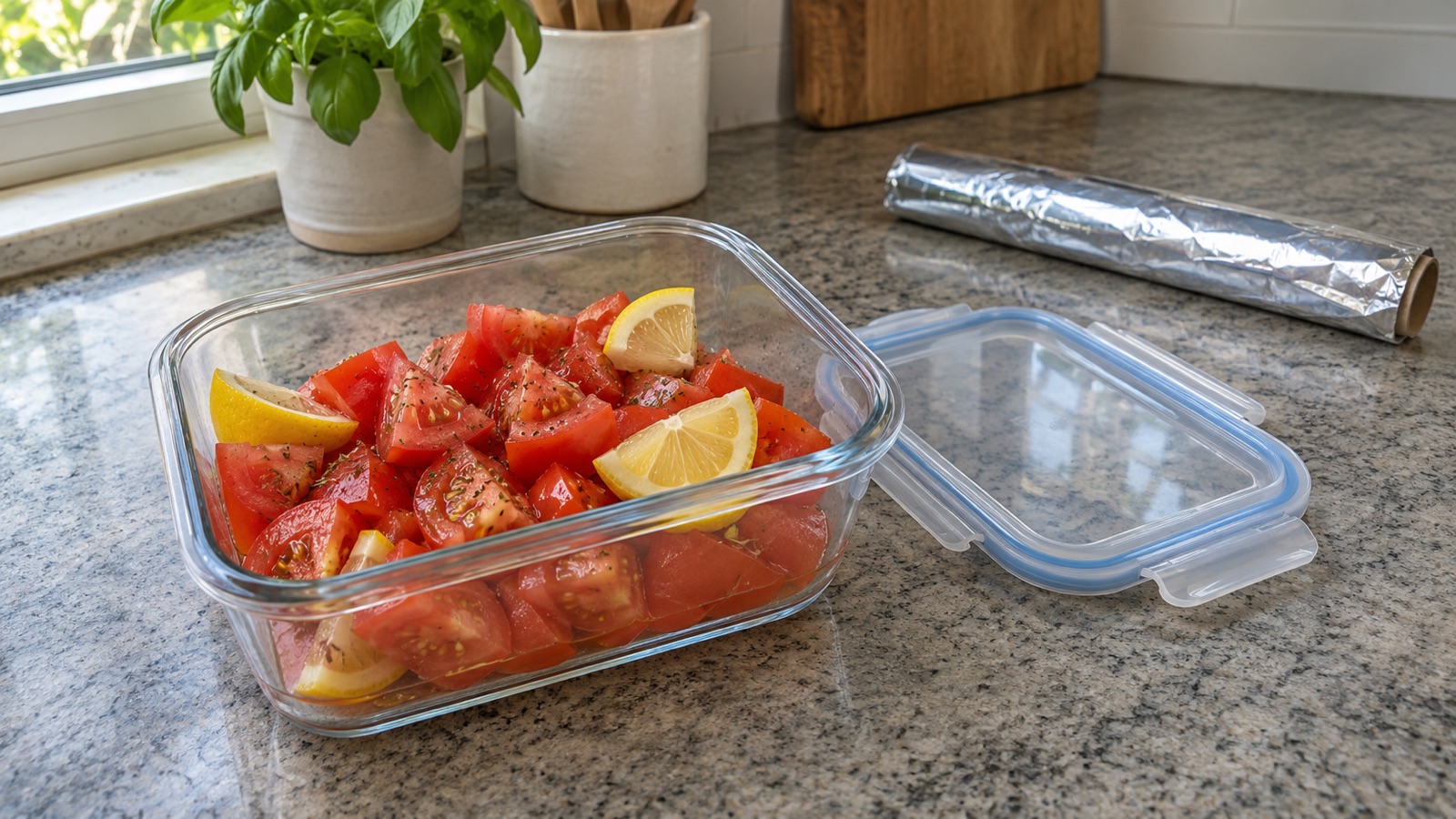
A practical example on the kitchen counter is tomato and lemon: place the chopped pieces in a suitable glass storage container and close it with its fitted lid. The roll of foil in the photo illustrates the limit of using foil: the foil does not touch the acidic food. This way you won't have to try to arrange a foil cover that stays clear of the food every time. Check that the glass is not broken or cracked, that the lid fits the container, and that the container is suitable for the intended use. Having a glass storage container does not mean that every model can go in the oven; Read separately for storage and cooking suitability.
Cold use does not remove the acid-salt rule. Do not assume that direct foil contact is suitable simply because salted cheese or lemon-seasoned leftovers will be stored for only one night. Foil is not a method that cools food or extends its storage life on its own; Food cooling and storage instructions also apply. Here, a common number of days is not given for all meals. Labeling the container with ingredients and preparation date makes it easier to follow the food's own storage guidelines. Covering the metal container with wet food with foil may also cause a different contact problem, so choose a suitable lid.
Finnish Food Authority · Food contact materials
Covering in the oven is not the same as covering the base
There are two different jobs in the oven: covering the pan and lining the inside of the pan. A loose covering over the top can be used to limit browning directly from above; A tightly closed cover retains more moisture. Weigh this difference against the outcome: sealing the food tightly throughout the entire cooking, where a crispy surface is desired, can change the intended result. When to open the cover depends on the recipe, the shape of the container and the behavior of the appliance. Do not transfer the temperature and time of another recipe here just because foil is used.
First measure the required length on the cold container, then fold excess edges securely; Do not leave any loose parts that could reach the hot heating element or fan. Foil manufacturer Reynolds recommends not covering the bottom of the oven with foil. Instead of placing a sheet on the bottom of the appliance to catch spills, follow the cleaning and tray positioning instructions in the appliance manual. Covering the entire shelf can also affect air circulation. When working with a covered container, carefully lift the cover away from you to prevent steam from escaping towards your face; Do not handle hot container with bare hands.
Shiny side, dull side and special coatings
The difference between shiny and dull sides in ordinary foil is caused by production. Reynolds explains that on standard foil, which side is facing out does not create a cooking advantage. On the other hand, special products sold as non-stick may have a coating on a certain side; The packaging tells which side of the product will face the food. Do not confuse these two pieces of information: do not automatically consider the ordinary dull side as non-stick, do not impose the same side orientation on coated products of all brands. If you threw away the box, identify the product instead of guessing the features.
Choosing thick foil can help with tear resistance, but thickness is not proof that contact with acidic food is allowed. Do not consider a coated tray as equivalent to an ordinary foil roll. Look for intended use, food restriction, and temperature instructions on the packaging. If the product is damaged or the coating is scratched, do not assume that the instructions for the intact product are still valid. Baking paper is another material; Evaluate it with its own temperature and device limits. Just because they are in the same drawer does not mean that one material will take over all the duties of the other.
Reynolds · Shiny and dull sides
Check the appliance and resolve common mistakes
Microwaves, conventional ovens and small air circulation appliances cannot be governed by the same rule. We do not recommend the use of foil in the microwave in this guide: some devices only allow limited use of metal under certain conditions, while the product instructions may be more restrictive. If you cannot find clear compatibility in both the appliance and foil instructions, use a microwave-safe container. Don't place loose foil in the air fryer by guessing either; Follow the device's own instructions regarding air flow and distance from heating elements. What works for one oven is not a substitute for permission for a different appliance.
The application sequence can be kept short: first assess the acidity and salt status of the food, then choose the container, and finally decide whether a cover or liner is really necessary. If the foil is puncturing or sticking to food, don't hide the cause by adding more layers; Re-evaluate direct contact, product and cooking pattern. If you need to cover the food, a suitable lid, or if you need a lining, the material allowed for that purpose may be the solution. The main goal is not to use foil in everything, but to bring the container, food and device instructions together in the same application.
Wolf · Microwave foil instructions
Read the comparison of baking paper and silicone mat when choosing a tray liner.
İyi Bir Yemek
Food Researcher & Writer
Reader Comments & Contributions
Be the first to share your thoughts on this post