
Egg Sizes S, M, L and XL: Shell-On and Edible Weight
Understand shell-on egg size classes and weigh the edible contents. Practical examples for whole eggs, whites, yolks, partial eggs and batch scaling.

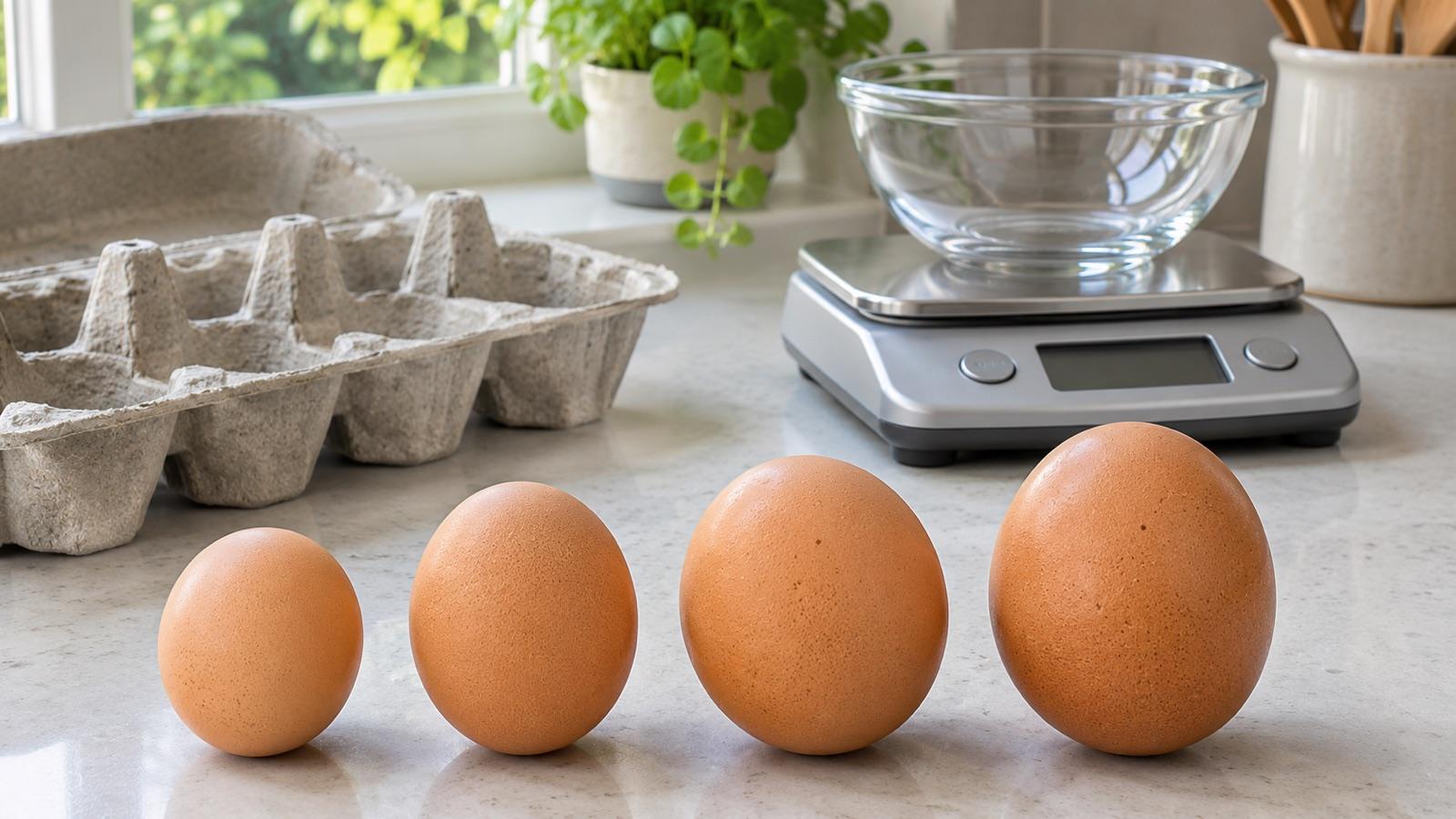
S, M, L and XL indicate the weight class of the egg with its shell; It does not tell you the exact grams of white and yolk you will use in the recipe. If a precise measurement is required, break the egg into a separate clean bowl, separate the shell and weigh the portion to be used in the tared container. This way, you won't confuse the gram on the package with the gram in the mixture. The following method is for chicken eggs. Calculation examples are hypothetical; It is not a measured test result or a conversion table valid for every egg.
What does the size class measure?
In the European Union regulation No. 2023/2465, class A chicken eggs are divided according to shell-on weight: S less than 53 g; M at least 53 g and less than 63 g; L at least 63 g and less than 73 g; XL at least 73g. An egg weighing exactly 63 g belongs to L; one weighing exactly 73 g belongs to XL. These intervals do not apply to shellless eggs. Do not automatically equate large in a recipe from another country with European class L; Read the recipe's measurement description.
Size is not a measure of quality or freshness. The proportions of shell, white and yolk of two eggs in the same class do not have to be the same. The class of the package provides initial information; does not guarantee the usable grams the recipe calls for. Before shopping, determine which measurement system the recipe uses. If only three eggs are written and no size is specified, review the author's material notes; Do not convert vague information into an exact gram number. You can write down the size you used and the total without shell in your own recipe record.
EUR-Lex · 2023/2465, Article 5
From shell-on weight to usable grams
Place the scale on a flat and hard surface and select the gram unit. Place an empty, clean, dry bowl; reset with the tare button. First break the egg into a separate small bowl, remove any visible shell bits with a clean spoon and transfer it to the bowl on the scale. When you lift the bowl off the scale and put it back down, wait for the measurement to stabilize. Do not put the shells in the weighing bowl. The weight of the container that is not zeroed can result in serious measurement errors in a few eggs.
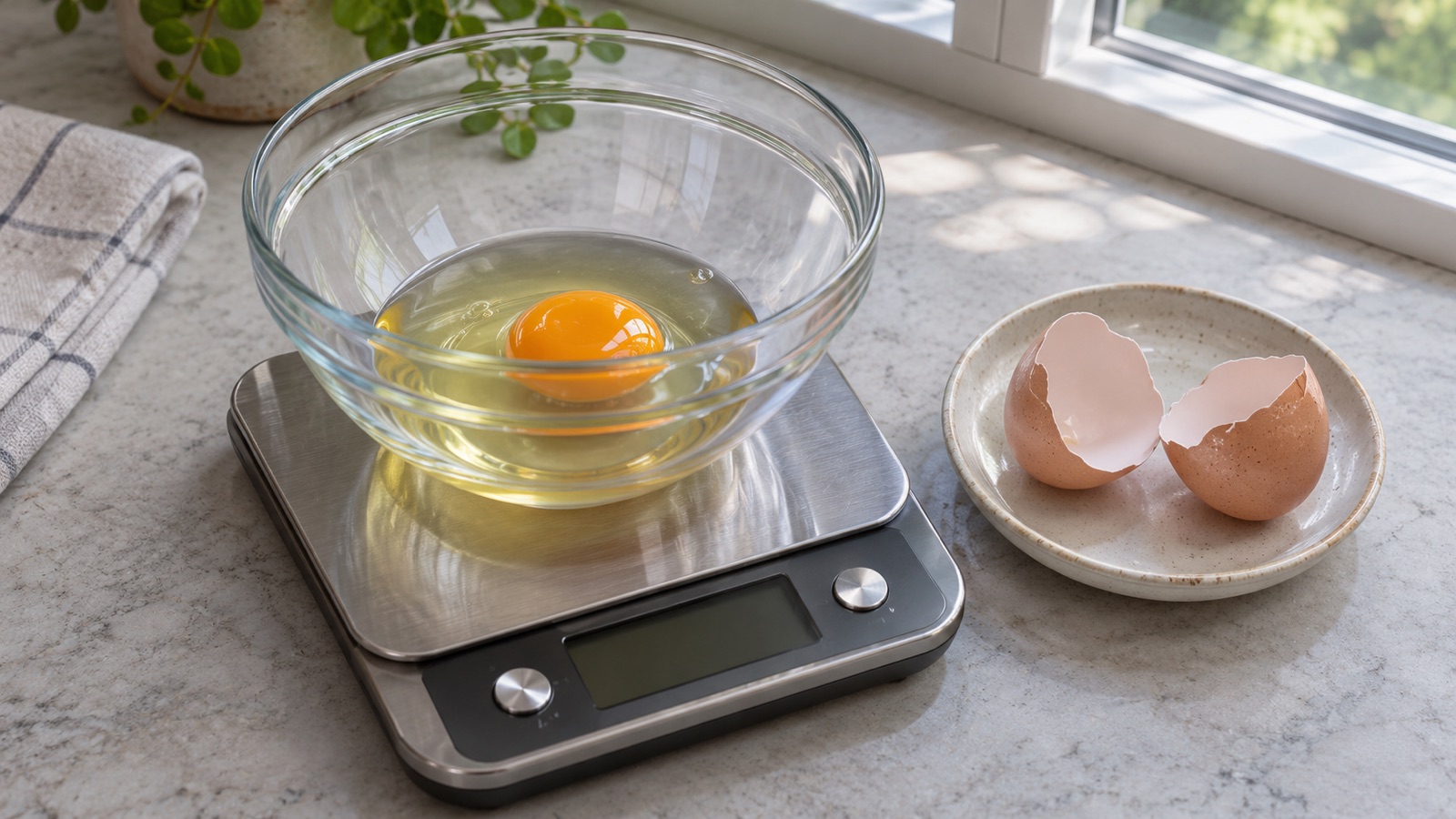
For example, imagine a shell-on egg weighing 61 g yields 54 g edible contents. Record 54 g as the recipe input, rather than 61 g. This does not mean that every M egg yields 54 g. When using several eggs together, weigh their combined contents instead of estimating each conversion. Do not let the outer shell touch the mixture while trying to recover the last drop. When finished, clean hands, utensils, equipment and surfaces that have touched raw egg.
Using grams and partial eggs instead of counts
If the recipe calls for 150 g of whole eggs without shells, break enough eggs and mix the whites and yolks with a fork until they are just homogeneous. Tare the bowl and reserve 150g of the mixture. Whisking and foaming is not necessary at this stage; The goal is to distribute the yolk and white similarly in each spoon. If the recipe is given in units, this method only provides an exact response if the target gram is specified. Changing the number of eggs also changes the mixing ratio when other ingredients remain the same.
For half an egg, do not try to split the egg in the shell by eye. Hypothetically, you can homogenize 52 g of shellless eggs and separate 26 g. This number varies in different eggs. If the scale's resolution is 1 g, you cannot reliably select decimal grams; It may be more feasible to slightly enlarge the batch requiring very small quantities. Put the separated raw mixture into the cooking process without delay. This guide does not assign a storage period to the remaining egg; for this, follow separate safety and storage instructions.
Why weigh whites and yolks separately?
Whole-egg weight cannot replace a measurement for whites alone or yolks alone. If a recipe needs 90 g egg whites, separate whites into a clean bowl with a clean egg separator and weigh the total, rather than assuming three eggs will suffice. Use a separate tared bowl for yolks. Allow the white time to drain through the separator. Use clean equipment rather than passing the contents between shell halves. For whipping whites, also ensure the bowl and tools are free from grease.
For example, a hypothetical batch yielding 100 g whites and 55 g yolks totals 155 g, but these components have different roles in a recipe. Replacing a missing 10 g white with 10 g yolk does not preserve the formula. If yolk enters whites intended for foam, a scale cannot correct the problem. Starting again with a clean bowl gives more control. Keep whole egg, white and yolk entries separate in your notes; calling all three simply egg makes the next attempt ambiguous.
Scaling batches and avoiding common mistakes
Consider that the recipe clearly calls for 200g of whole eggs and you're going to make half a batch: the target becomes 100g. For one and a half batches you will need 300 g. Scale other ingredients by the same factor; Do not assume that tray size and baking time will vary at the same rate. Recording the actual shell-free total first in a recipe written by quantity allows you to establish the same ratio the next time you try. Do not present the number you found by calculation as if it were a standard that the source did not specify.
The most common mistakes are writing the shell-on weight as the recipe input, forgetting the tare, counting whole eggs and whites as the same, and equating the size names of different countries. If your measurement is unexpected, first check the unit, tare of the container, and what portion you are weighing. Do not perform a safety check by tasting the raw mixture. The FDA recommends pasteurized egg products in applications where they will be served with raw or undercooked eggs. Weighing determines the quantity; It does not eliminate the need for safe cooking and clean working.
Guide to storing eggs in the refrigerator for topics other than weighing
İyi Bir Yemek
Food Researcher & Writer
Reader Comments & Contributions
Be the first to share your thoughts on this post