
Dry and Cooked Pulse Weights: Yield and Portion Calculations
Separate the weight of dry, soaked and cooked pulses. Straining method for chickpeas, beans and lentils, calculating your own yield and portion examples.

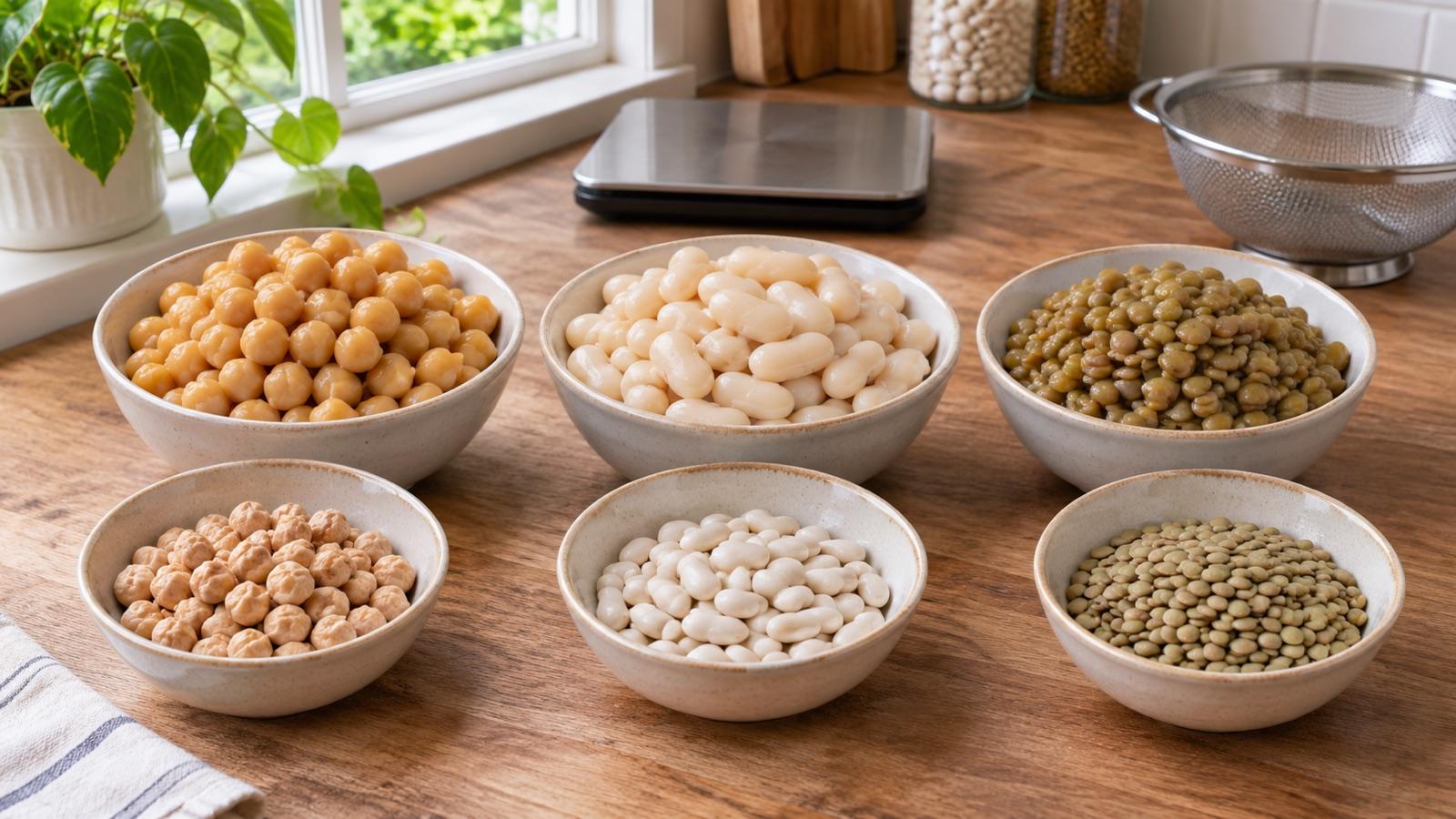
There is no single reliable multiplier for converting dry pulses into cooked weight. Weigh the sorted dry pulses and then the cooked pulses drained consistently, and calculate the yield of your own batch. This separates the amount you buy from the grams on your plate. This guide explains a weighing method for chickpeas, beans and lentils rather than giving a cooking recipe. All numerical examples below are hypothetical arithmetic examples, not kitchen trial results or standard product yields.
Distinguish four different weights
Dry weight means the edible pulses weighed after removing stones and damaged seeds, before any contact with water. The package net weight covers the whole contents; sorting may slightly reduce the amount going into the pot. Soaked weight describes pulses that have absorbed water but have not yet been cooked. Record it if useful, but do not treat it as a cooked serving. Weighing the soaking bowl with its water does not measure the pulses alone.
Define cooked weight too: does it include the cooking liquid, or only drained pulses? Soup weight and drained chickpeas for a salad are different measurements. Pulses absorb water during soaking and cooking, while surface water also affects the final reading. Equal gram weights of dry and cooked lentils do not represent the same starting amount. Write dry, soaked or cooked-and-drained beside every entry to remove ambiguity.
Set up a repeatable weighing method
Put the scale on a flat, firm surface and select grams. Place an empty dry bowl on it and tare the scale. Record the sorted dry chickpea weight, product name and date. Prepare the pulses according to their packaging or a reliable cooking guide. Do not undercook chickpeas or beans for the sake of measurement. For lentils, choose the cooked texture suitable for their intended use. The aim is to measure edible food, not to maximize the number.
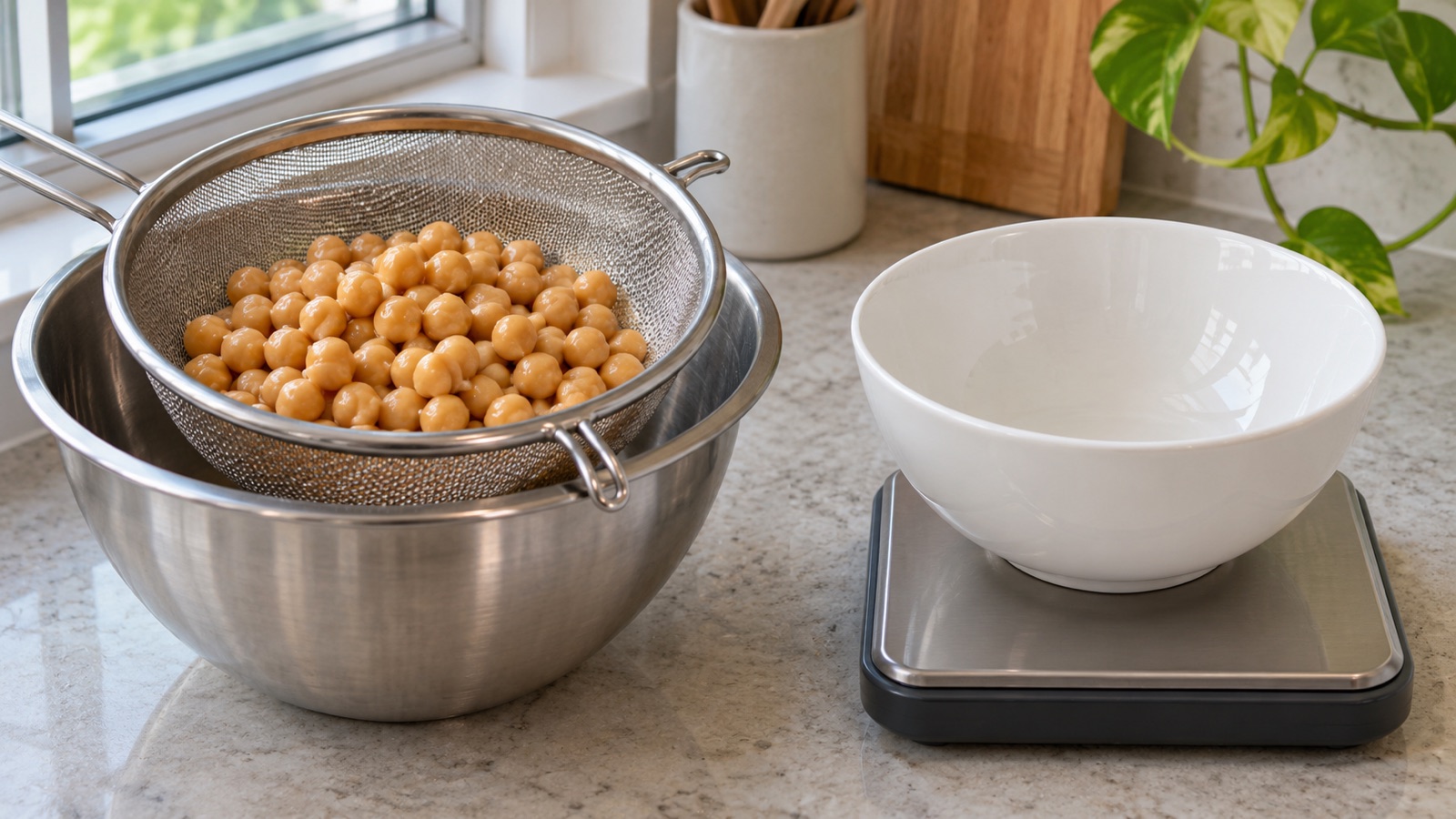
Transfer the cooked pulses to a clean sieve and weigh after freely running water has drained away. For consistency, you could choose a two-minute draining interval and use the same sieve and interval for later batches; this is a household convention, not a universal laboratory standard. Do not squeeze the pulses or blot them dry, since that creates a different measurement. Follow your scale’s restrictions on hot containers. Keep the sieve out of the sink and on a clean surface. Weigh warm pulses in a suitable bowl without leaving them on the counter for a prolonged cooling period.
Nebraska Extension · Dry beans
Calculate your own yield and portions
Yield factor = cooked-and-drained grams / dry grams. In a hypothetical chickpea batch, 200 g dry pulses producing 460 g cooked-and-drained pulses gives a factor of 2.30. Divide that batch into four equal containers and each contains 115 g. Each corresponds to 50 g of the original dry pulses; it does not mean the container still holds 50 g of dry chickpeas. If you add other ingredients, calculate the final dish’s portion weight separately.
A sample log could read: chickpeas 200 g → 460 g → 2.30; beans 200 g → 500 g → 2.50; green lentils 200 g → 440 g → 2.20. All three rows are hypothetical arithmetic examples. Replace them with your own measurements. Suppose you need six containers holding 120 g cooked beans each: the total is 720 g. With your measured factor of 2.50, the starting estimate is 720 / 2.50 = 288 g dry beans. Since the next batch may differ, weigh it again before dividing it into portions.
Why can results differ even with the same package?
Pulse variety, final texture, soaking method and draining procedure all affect the comparison. Do not force intact green lentils and broken-down red lentils into the same factor. Record whether you removed chickpea skins or lost broken bean pieces through the sieve. Unless the edible portion is defined consistently, two accurate readings can still produce a misleading comparison. A previous batch provides only a starting estimate.
Do not add water merely to correct a low reading: when a salad needs drained pulses, added water does not increase the relevant edible yield. Longer draining reduces a wet batch’s measured weight without necessarily indicating poorer cooking. Note when salt, oil or sauce is added. Do not calculate plain pulse yield from the final weight of an oily or sauced mixture. Several batches measured under similar conditions provide a more useful kitchen reference than one internet multiplier.
Shopping, nutrition records and safe portioning
Do not compare the price of dry pulses directly with the price per kilogram of cooked pulses. For a hypothetical dry bean price of 100 TL per kilogram and a yield factor of 2.50 measured in your kitchen, the raw ingredient cost is 40 TL per cooked kilogram. Energy, water, waste and labour are excluded. For canned products, use the drained portion you will actually use rather than the total net weight. Your yield helps with budgeting but does not guarantee the same result for another brand.
For nutrition records, check whether the label or database entry describes dry or cooked food. Applying a dry product’s per-100-g value to cooked grams mixes two different bases. A weight factor alone does not provide a complete nutrient conversion. After weighing, divide cooked pulses into small shallow containers and refrigerate promptly. FDA guidance limits room-temperature time for foods needing refrigeration to two hours, or one hour above 32°C, and recommends a refrigerator temperature no higher than 4°C. Recording weights must not delay safe cooling.
USDA FoodData Central · Documentation · FDA · Food storage
Learn how to tare a kitchen scale to exclude the bowl weight
İyi Bir Yemek
Food Researcher & Writer
Reader Comments & Contributions
Be the first to share your thoughts on this post