
Red, Green and Yellow Lentils: Choose Whole or Split?
Choose lentils for soup, purée or salad by seed structure as well as colour. Learn to read the pack and run a small, useful texture check.

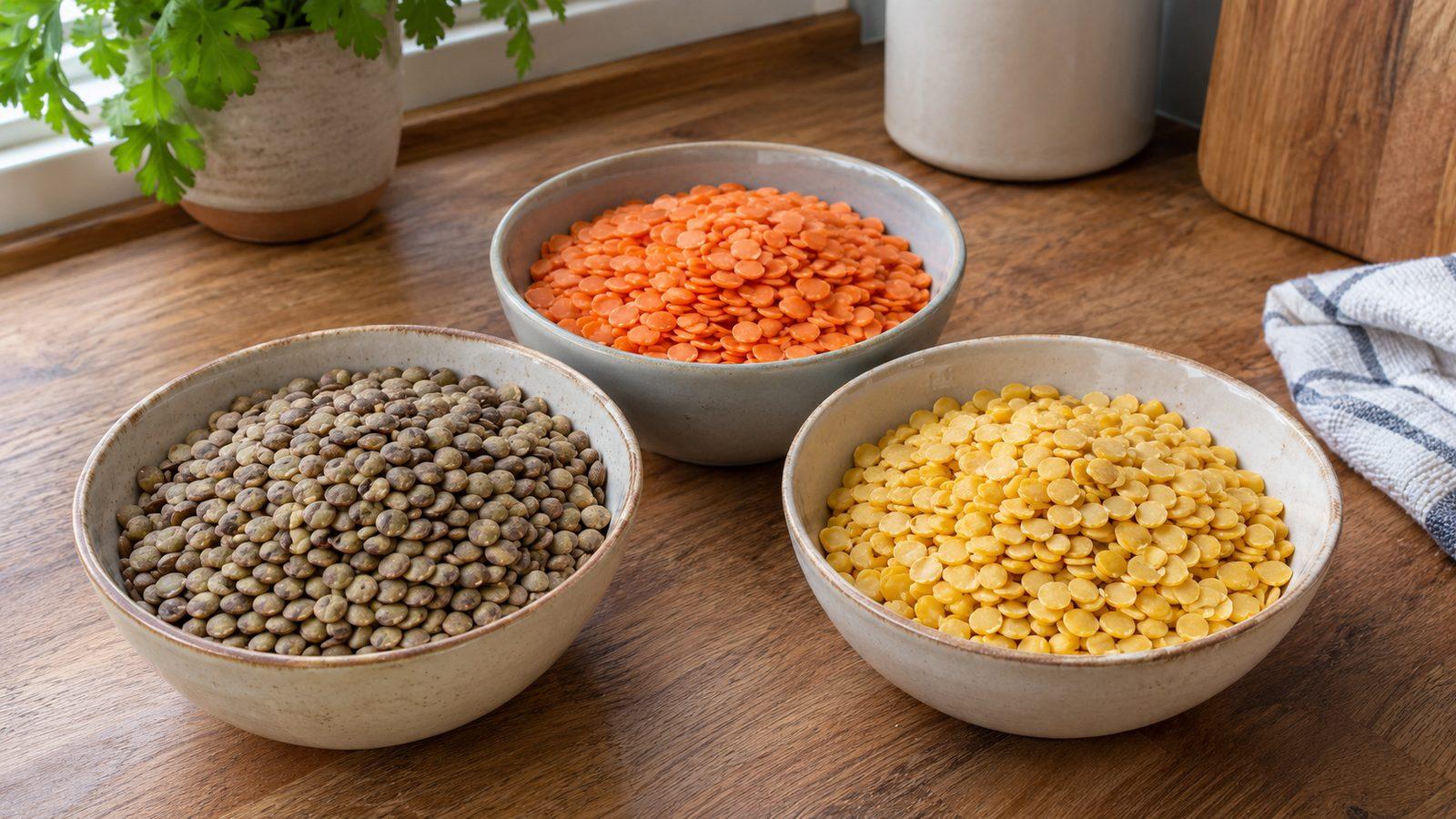
Hulled split lentils usually make smooth soup and purée easier, while whole lentils with their skins are a useful starting point for distinct salad grains. Colour alone cannot settle the choice: whole red and split red lentils are different product forms. Start with the dish, then check seed structure and the packet instructions. This is a kitchen decision guide, not a promise that every variety takes identical time or water.
Look at the seed before the colour
Do not stop at “red” or “green” on the front of the bag. Read the product description for whole, skin-on, hulled or split. Through a clear window, a whole seed looks like a small lens with both halves together; a split seed exposes its flatter inner face. Whole does not automatically mean skin-on, because hulled whole products also exist. Check that a yellow product really is lentil: yellow split peas may look similar but are a different pulse.
Red and yellow lentils are often sold split and green lentils whole, but this is a retail pattern rather than an unchanging rule. Two bags with the same colour name may have different seed structures. Do not treat a quick-cooking claim as proof that whole red and split red products are interchangeable. At a loose-food counter, ask whether the skin has been removed and whether the seeds are split. If the answer is unclear, buy a small quantity before committing to a delicate salad recipe.
Lentils.org · Whole and split lentils
Choose the texture your dish needs
For a strained or blended soup, breaking down is useful rather than a defect: softened split seeds help produce a smooth result. The same behaviour may erase the separate grains wanted in a lemon-dressed salad. Whole skin-on lentils are a useful starting point for salads, vegetable side dishes and mixtures where seeds should remain visible. Split red or yellow lentils suit thick purées and soups that coat a spoon. For a brothy dish, decide whether you want visible lentils or a thickened liquid.
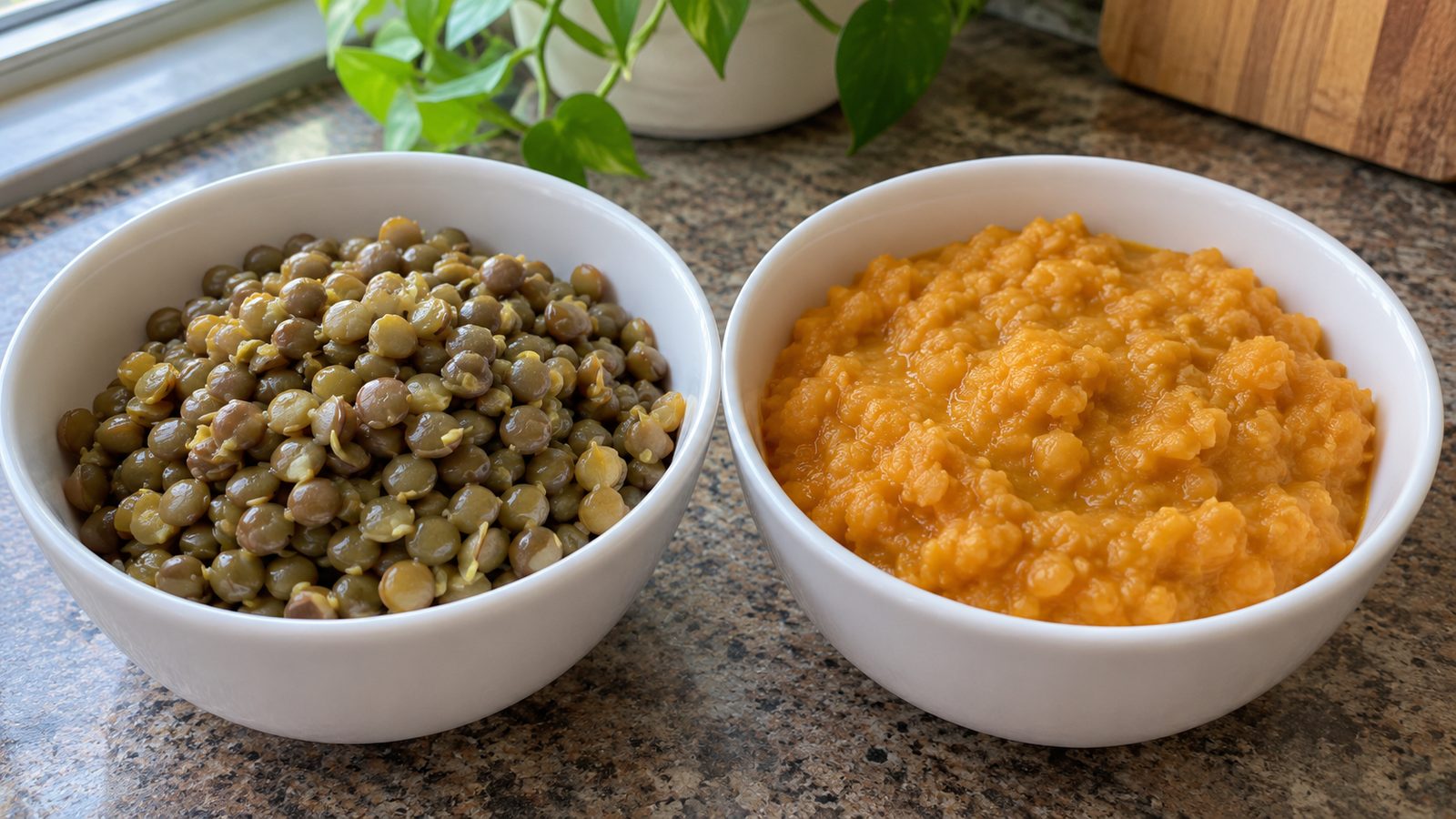
You can adapt a recipe to the packet already at home, but redefine the expected result. Whole green lentils do not make the same purée as split red lentils in the same time. Shortening cooking alone cannot always turn split lentils into salad grains. If using both forms together, adding them at different stages or cooking separately gives more control. The illustration shows a general texture distinction; it is not a photograph of a matched cooking experiment or a guarantee of final colour.
Lentils.org · Whole and split lentils
Check the packet with a small batch
Spread the dry lentils on a plate, remove stones and foreign material, then rinse in a fine sieve under running water. The cited guidance does not require presoaking lentils. Still read any product-specific instructions, particularly for a pretreated product. Try an unfamiliar bag in a small batch before filling a large pot. For a comparison, weigh 50 g of whole lentils and 50 g of split lentils separately. Use two similar pots and follow each product's own water and timing directions.
This is not an experiment that blindly gives both pots identical water. The purpose is to see how equal dry weights fit your intended dish, not to measure absorption. Once boiling, reduce to a gentle simmer. Near the end of the packet's suggested time, remove a sample with a clean spoon and let it cool slightly. For separate grains, look for a tender interior that retains its shape when gently stirred. For purée, look for seeds that crush easily. Note the product name and your observed endpoint; that personal kitchen note is not a guarantee for all varieties.
Lentils.org · Whole and split lentils · Iowa State University · Lentils
Manage water separately from texture
When whole lentils are tender, drain excess liquid if necessary. Continuing solely to boil the water away may sacrifice the grain structure. Vigorous shaking in a sieve and rough stirring while hot can also damage salad lentils. Move them to a broad bowl and fold dressing in gently. With soup, manage consistency instead of draining the lentils away: add hot water gradually if it becomes too thick and reassess after each addition. Check near serving temperature as well as while boiling.
Do not immediately thicken a watery purée with more dry lentils from another bag. Newly added seeds will not finish at the same time as the cooked portion. First check whether the existing lentils are actually tender, then consider reducing liquid uncovered under observation or serving the mixture as soup. The aim is not to force every packet into one recipe. Keeping separate small bags for soup and salad may help reproduce preferred textures, but let actual use determine how much cupboard space they deserve.
A shopping check and common corrections
Ask three practical questions: which dish, which seed structure, which packet directions? Read product identification and date information, and check that the packaging is intact. Mixing different products in one jar makes later cooking less predictable, so retain the label. Avoid shortcuts such as darker always meaning better quality or yellow always meaning faster cooking. This guide makes no health ranking or unsupported nutrient comparison between colours; its criteria are use and texture.
If salad turns mushy, review the whole-product choice, simmering intensity and draining point together. If soup stays gritty, check that the seeds are tender before simply extending blending. Can green lentils go into soup? Yes; the point is that whole and split products give different results. To make the shopping decision concrete, read the ingredients and steps in the site's existing red lentil soup, then assess whether your packet suits that intended texture.
İyi Bir Yemek
Food Researcher & Writer
Reader Comments & Contributions
Be the first to share your thoughts on this post