
How to Measure Salt for Bread Dough in Grams
Weigh salt for bread dough, calculate baker’s percentages from flour weight, and check how many grams your own level spoon of salt holds.

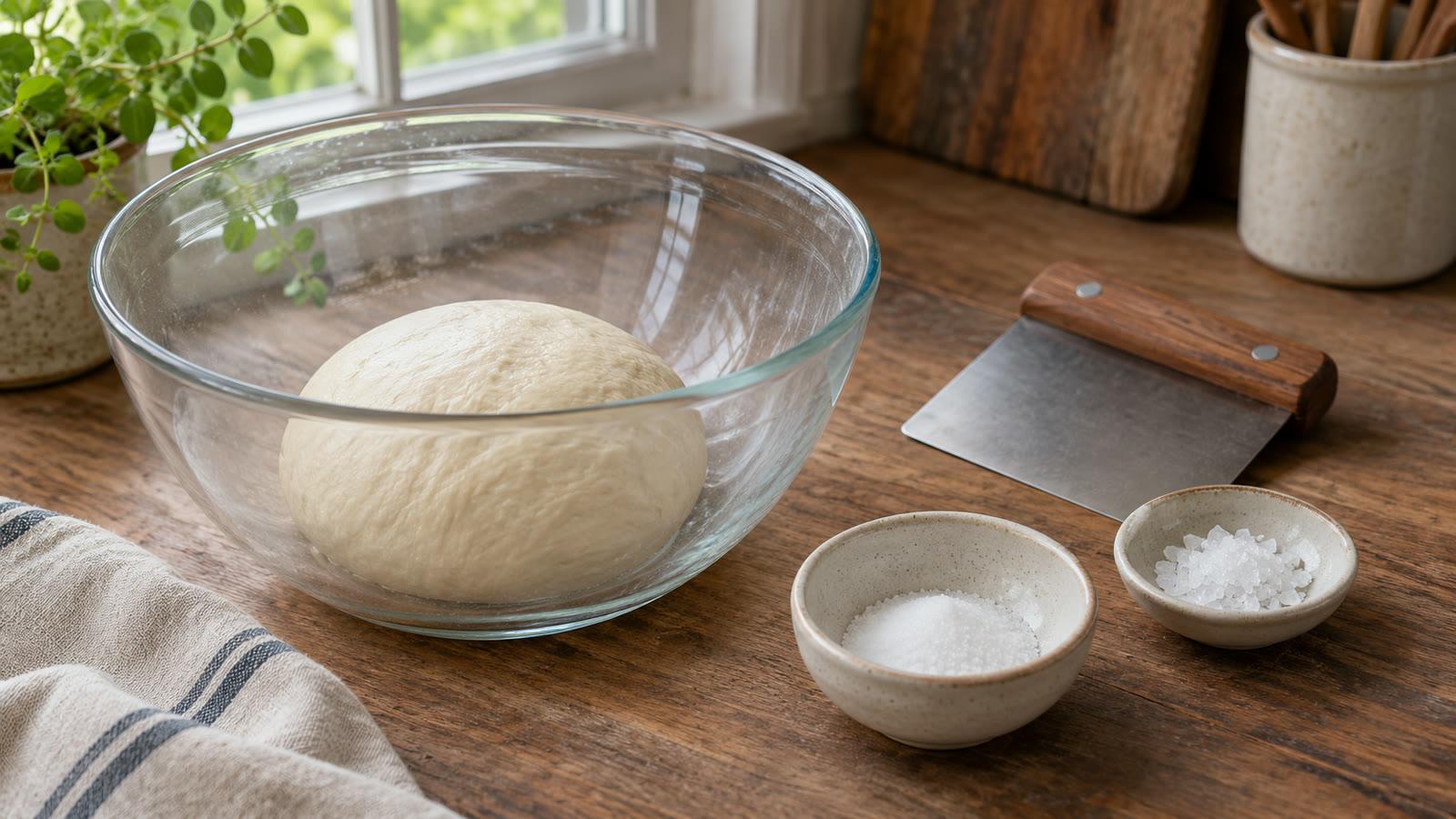
For consistent bread dough, weigh the salt in grams as specified by the formula. If the recipe only gives spoon measures, check which salt the author used. Fine table salt, coarse crystals and flakes can weigh different amounts in the same spoon. Knowing how much your salt weighs is especially useful when you open a new brand and want to reproduce a loaf you already like.
Why equal spoonfuls weigh differently
A spoon measures volume. Fine crystals can pack close together, while large or uneven crystals can leave more air between them. Shaking the spoon, leaving it heaped or sweeping it level also changes the amount it holds. Labels such as “fine” and “coarse” give a clue about texture, but they cannot give you an exact weight conversion.
For 1 tablespoon, King Arthur Baking’s chart lists 18 g for table salt, 16 g for Morton kosher salt and 8 g for Diamond Crystal kosher salt. These are examples for the products and measures listed. Even two salts sold as kosher salt have quite different weights by volume, so a conversion for a particular product may give the wrong result for a different brand or country.
King Arthur Baking — Ingredient Weight Chart
Weigh the salt you actually use
Put the scale on a firm, flat surface, set it to grams, and tare a small dry bowl. When the recipe gives grams, add the salt in small increments. If you overshoot, take some out before mixing. This is much easier than removing salt from a bowl of flour. When measuring a small quantity, check the minimum load and the increment the scale displays.
For a spoon-only recipe, fill a dry standard measuring spoon loosely, sweep the top level with a straight edge, and empty it into the bowl. If one spoonful is too light for a useful reading, weigh 3 level spoonfuls together and divide the total by 3. Repeat with the same salt and note the brand, spoon size and filling method. The result belongs to that combination, so keep the details with the number in your recipe notebook.
If you have two salts, use the same spoon and scale for both. Empty the bowl and tare again before weighing the second product. With a salt mill, grind at the setting you will use in the recipe before measuring. A volume conversion for the whole crystals may no longer apply once ground. If the scale struggles with small quantities, record the average of several spoonfuls instead of guessing a decimal digit. Repeat when the product or mill setting changes.
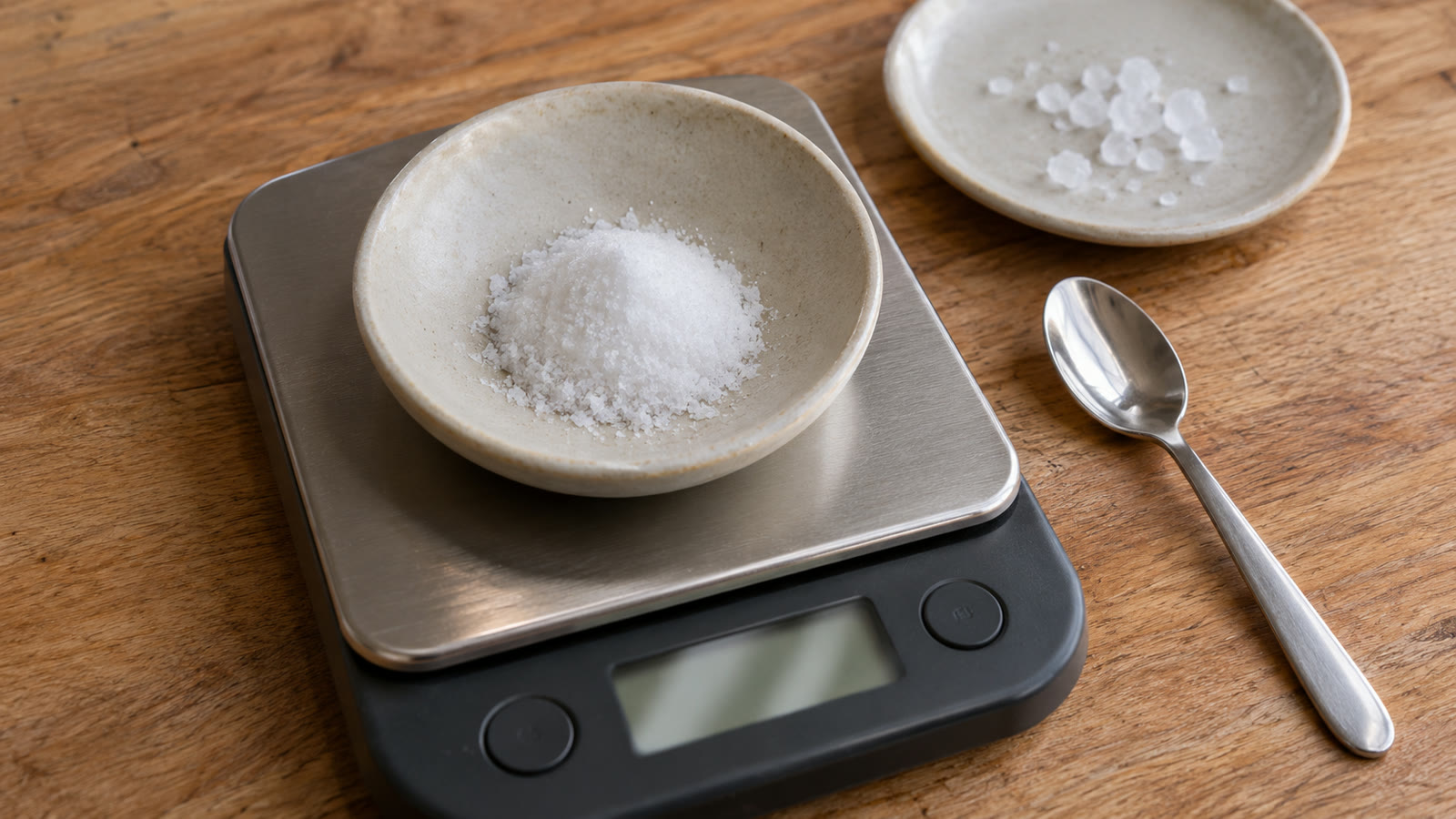
King Arthur Baking — A Digital Kitchen Scale
Work out the amount from the flour weight
In baker’s percentages, flour is the reference. Multiply the flour weight by the salt percentage and divide by 100. At 2% salt, 500 g of flour takes 10 g of salt and 350 g takes 7 g. These are examples of the calculation. If you are scaling an existing formula, keep its salt percentage and account for all the flour listed.
A loaf with 300 g white flour and 200 g whole wheat flour still starts from 500 g total flour. Whole wheat flour alone would give the wrong base. If the flour in a preferment is listed separately, include that flour when building a total formula. Calculating from the weight of the water or of the finished dough will give a different quantity.
King Arthur Baking — Baker’s Math
What to watch when changing salts
Salt affects flavor, gluten structure and the pace of yeast fermentation. With less salt the dough may ferment faster. To see what changes when you switch products, keep the flour, water, yeast, room temperature and salt weight as consistent as you can. If several variables change at once, differences in the rise or feel of the dough are harder to interpret.
For a plain yeasted loaf, compare 10 g of fine salt with 10 g of plain coarse salt and pay attention to how the crystals disperse. If the mixing method allows, dissolve coarse salt in some water reserved from the formula. Adding fresh water on top of the amount in the recipe changes the hydration. If grains remain obvious after kneading, try fine salt on the next bake.
King Arthur Baking — Baking School: Yeast Bread Ingredients
Spot recipe and measurement errors
If a recipe says only “a spoonful of salt,” look for the author’s measurement chart or recipe notes. Weighing your salt tells you how much your own spoon holds. The recipe notes are the place to find what the author intended. On the first bake, record the weight you used alongside the result. To compare the next loaf, adjust just that one quantity and make the same distinction between a level and a heaped spoon.
Flaky finishing salt has another job. Measure the salt inside the dough and the flakes on top separately so you can reproduce both the crumb and the salty spots on the crust. If the loaf rises surprisingly fast or slowly, recheck the salt and also review the yeast type, yeast dose and dough temperature. Start the next test with the same bowl, spoon and measuring routine.
Compare yeast types · Instant versus active dry yeast
İyi Bir Yemek
Food Researcher & Writer
Reader Comments & Contributions
Be the first to share your thoughts on this post