
The History of Olive Oil: From Ancient Anatolia to Your Table
The 7,000-year history of olive oil from Klazomenai to Rome, how it is made, its grades, Türkiye's olives, and tips for choosing and storing it.

Olive oil is more than an ingredient in Mediterranean cooking. It is a memory thousands of years long. It has lit oil lamps, been rubbed on athletes, been offered in temples, crossed seas in ships, and it still sits at the heart of our tables today.
In this guide you will find the history of olive oil from Anatolia to Rome, how it is made, its grades, Türkiye's best-known olive varieties, and how to choose and store a good olive oil.
A short history of olive oil
The first drops: the Eastern Mediterranean
The olive tree was domesticated from its wild form on the shores of the Eastern Mediterranean thousands of years ago. Stone basins and olive pit remains found at submerged ancient settlements near today's Haifa show that people were extracting oil from olives around 7,000 years ago. The first methods were very simple: olives were crushed with stones, the paste was mixed with hot water, and the oil that rose to the surface was collected by hand.
Over time olive oil became one of the most valuable trade goods of the Eastern Mediterranean. Its traces appear in the records of Ugarit on the Syrian coast, in the giant storage jars of the Minoan palaces on Crete, and in Egyptian tombs.
Anatolia's olive oil workshops
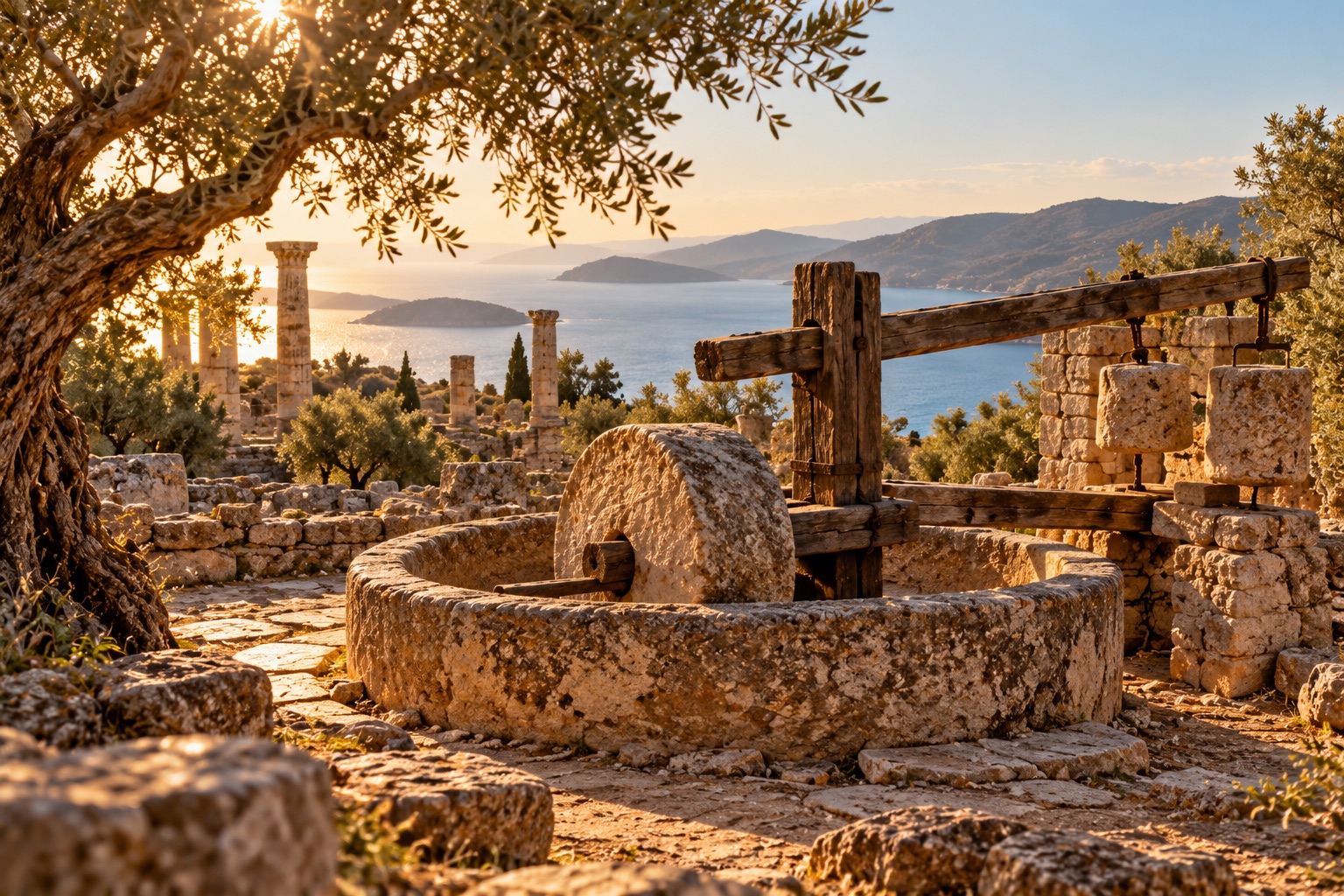
Anatolia is not on the edge of this story but right at its center. The olive oil workshop uncovered at the ancient city of Klazomenai, in today's Urla near İzmir, dates to the 6th century BC and is considered one of the oldest known industrial olive oil facilities in the world. After the excavations, its weighted lever press was rebuilt and used to make oil again the ancient way.
Similar stone presses, crushing basins and oil stores have been found in many ancient cities along the Aegean and Mediterranean coasts. They show clearly that olive oil was the backbone of the region's economy.
The Greek and Roman world
In ancient Greece the olive tree was sacred. According to legend, Athens took its name from the goddess Athena, who gave the city an olive tree. Winners of the Panathenaic Games received decorated amphorae filled with olive oil. Athletes rubbed the oil on their bodies, and it was also used as lamp fuel, as medicine and as a base for perfume.
Under Rome, the olive oil trade reached an enormous scale. Monte Testaccio, a hill in Rome, is made largely of fragments of millions of amphorae that carried olive oil and were then broken and discarded. This artificial hill is the most striking proof of how much olive oil the empire consumed.
From the Ottomans to today
In the Ottoman period the Aegean and Marmara coasts, especially around Ayvalık, Edremit and Gemlik, became known for olive oil and olive oil soap. The stone oil mills and soap works of Ayvalık are traces of that era you can still see today.
In the 19th and 20th centuries hydraulic presses spread, followed by continuous centrifuge (decanter) systems. Today olives can be processed within hours of harvest, which makes fresher, higher-quality oils possible.
How is olive oil made?
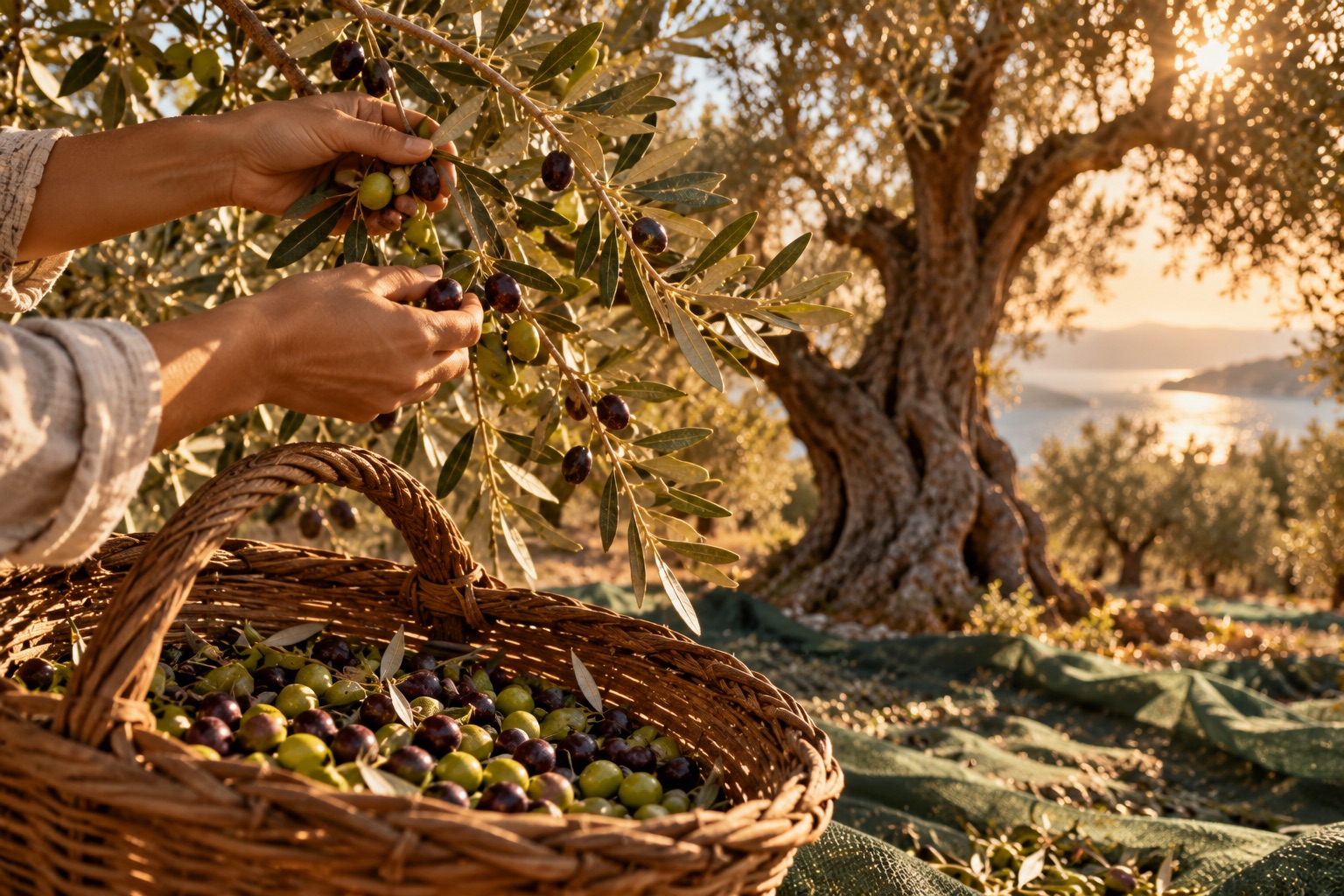
Good olive oil starts in the grove. Olives are usually harvested between October and January. Early-harvest green olives give less oil, but it is more intense, fruity and slightly bitter. Riper black olives give a softer oil, and more of it.
Production comes down to these steps:
- Washing and sorting: Leaves and twigs are removed and the olives are washed.
- Crushing: The olives are crushed, pits and all, into a paste.
- Malaxation: The paste is stirred slowly for a while so the tiny oil droplets join together. Keeping the temperature low at this stage protects the aroma. "Cold extracted" means this is usually done below 27°C.
- Separation: A centrifuge separates the oil from the water and the olive pomace.
- Settling and filtering: The oil is left to rest so the sediment sinks, and it may be filtered.
Grades of olive oil
Olive oils are graded by their free acidity and their sensory qualities. Acidity is about quality, not taste: you cannot taste it as sourness.
- Extra virgin olive oil: Made only by mechanical means, with acidity of at most 0.8% and no taste defects. This is the highest grade.
- Virgin olive oil: Also made by mechanical means, with acidity of at most 2%. It is less intense than extra virgin.
- Refined olive oil: Made by refining defective virgin oils. Its taste and aroma are neutral.
- Olive oil (pure / "riviera"): Refined olive oil blended with some virgin oil. It is milder and often used for frying and everyday cooking.
- Olive pomace oil: Extracted from olive pomace with solvents. It cannot be sold as olive oil.
Türkiye's olives
Türkiye is one of the world's leading producers of olives and olive oil. Each region's olive gives the oil its own character:
- Ayvalık (Edremit): The symbol of the northern Aegean. It gives an elegant, soft, fruity oil with notes of almond and fresh herbs.
- Memecik: The common variety of the southern Aegean (Aydın, Muğla, İzmir). More pronounced bitterness and pungency, with intense green aromas.
- Gemlik: Best known as the black table olive of the Marmara region. Its oil is balanced and mild.
- Nizip Yağlık and Kilis Yağlık: The oil olives of the southeast. They give strong, characterful and usually more intense oils.
- Domat, Uslu, Trilye: Mostly known as table olives, but they also appear in local oils.
How to tell a good olive oil
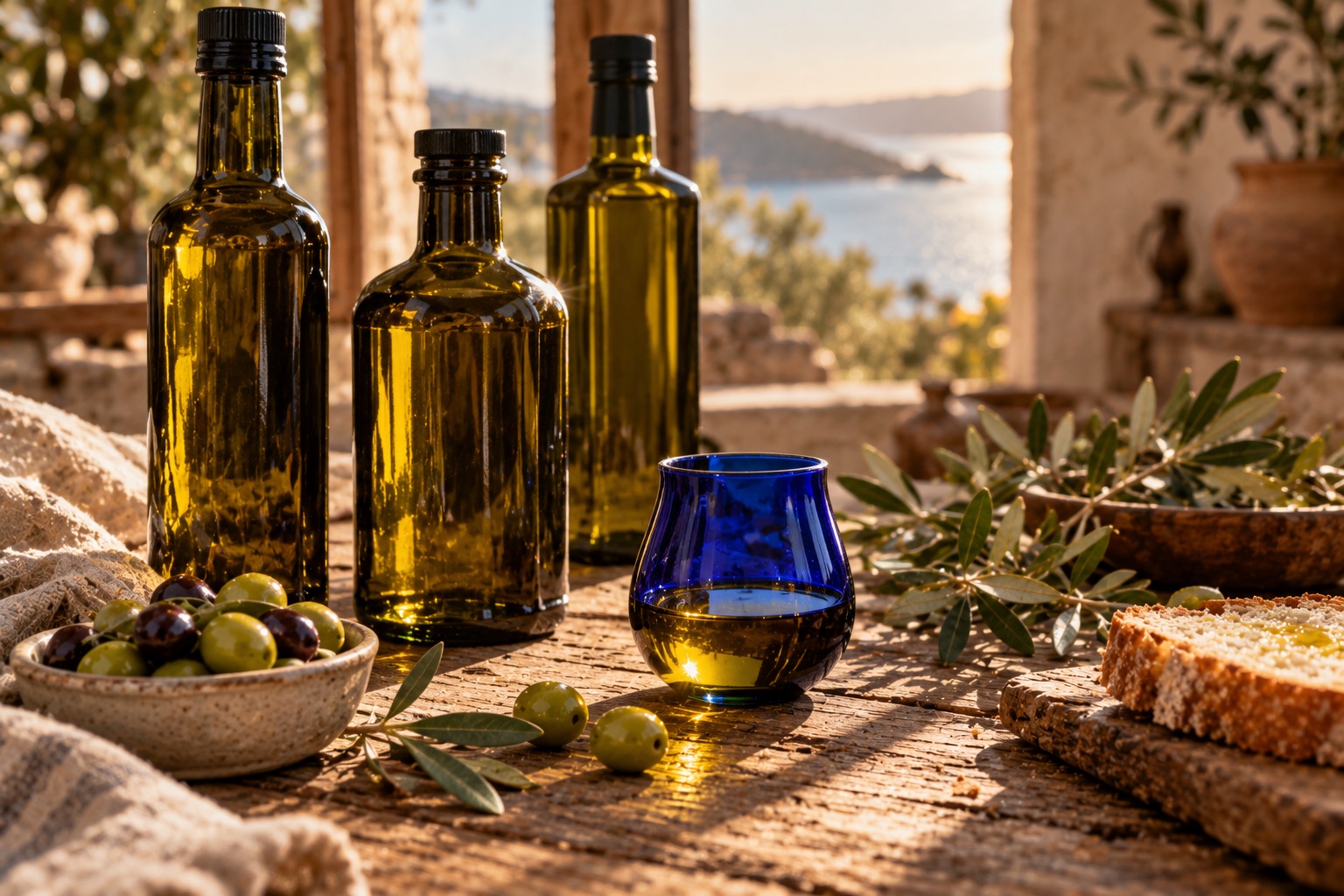
The color of olive oil says nothing about its quality. That is why professional tasters use dark blue glasses. What matters is aroma and taste:
- Fruitiness: Aromas of fresh olives, cut grass, green apple, tomato leaf or almond are a good sign.
- Bitterness: A light bitterness at the back of the tongue is not a defect. It is a sign of freshness and polyphenols.
- Pungency: A slight peppery burn in the throat as you swallow is also a positive trait.
Sour, musty, vinegary, metallic or stale-walnut smells, on the other hand, show that the oil has gone off or was poorly made.
Choosing and storing olive oil
For a step-by-step look at the label, aroma and taste, read how to tell real olive oil before you buy it. In short:
- Check the harvest date: Olive oil does not improve with age like wine. Its best period is the first 12–18 months after harvest.
- Choose dark glass or tins: Light is one of the oil's worst enemies. Avoid clear plastic bottles.
- Keep it somewhere cool and dark: Next to the stove or on a sunny windowsill is not a good place. It does not need the fridge. It may turn cloudy there, but that does not mean it has spoiled.
- Close the cap tightly: Contact with air speeds up oxidation. Decant a large tin into a small bottle a little at a time.
- Know its origin: Oils whose label names the region, variety and producer are more trustworthy.
Olive oil in the kitchen
Extra virgin olive oil is ideal for salads, meze and Turkish-style vegetables cooked in olive oil. It shows its aroma best when drizzled over a dish after cooking. Contrary to popular belief, a good extra virgin olive oil also holds up to home sautéing and frying temperatures, because its high monounsaturated fat and antioxidant content protects it against heat.
A practical everyday approach: an intense, fruity extra virgin for raw use and finishing touches, and a milder, more affordable virgin or pure olive oil for long cooking and frying.
Olive oil and health
Olive oil is the cornerstone of the Mediterranean diet. It is mostly made of monounsaturated fatty acids such as oleic acid. The polyphenols in extra virgin olive oil contribute to protecting blood lipids from oxidative stress. For this effect, about 20 grams (roughly two tablespoons) a day of high-polyphenol olive oil is recommended. Still, olive oil is calorie-dense. It helps when it replaces saturated fats, not when it is added on top of them.
This information is general. If you have a particular health condition, make decisions about your diet together with a professional.
For more on its benefits and how to use it well in the kitchen, see our olive oil benefits guide.
Final word
A bottle of olive oil holds the stone presses of Klazomenai, the amphorae of Rome, the oil mills of Ayvalık and this year's harvest all at once. Choosing a good olive oil means making room for that long story at your table. Next time you shop, take one more look at the label, the harvest date and the color of the bottle. Then dip some bread in the oil and taste it: is it fruity, slightly bitter and a little peppery in the throat?
İyi Bir Yemek
Food Researcher & Writer
Reader Comments & Contributions
Be the first to share your thoughts on this post